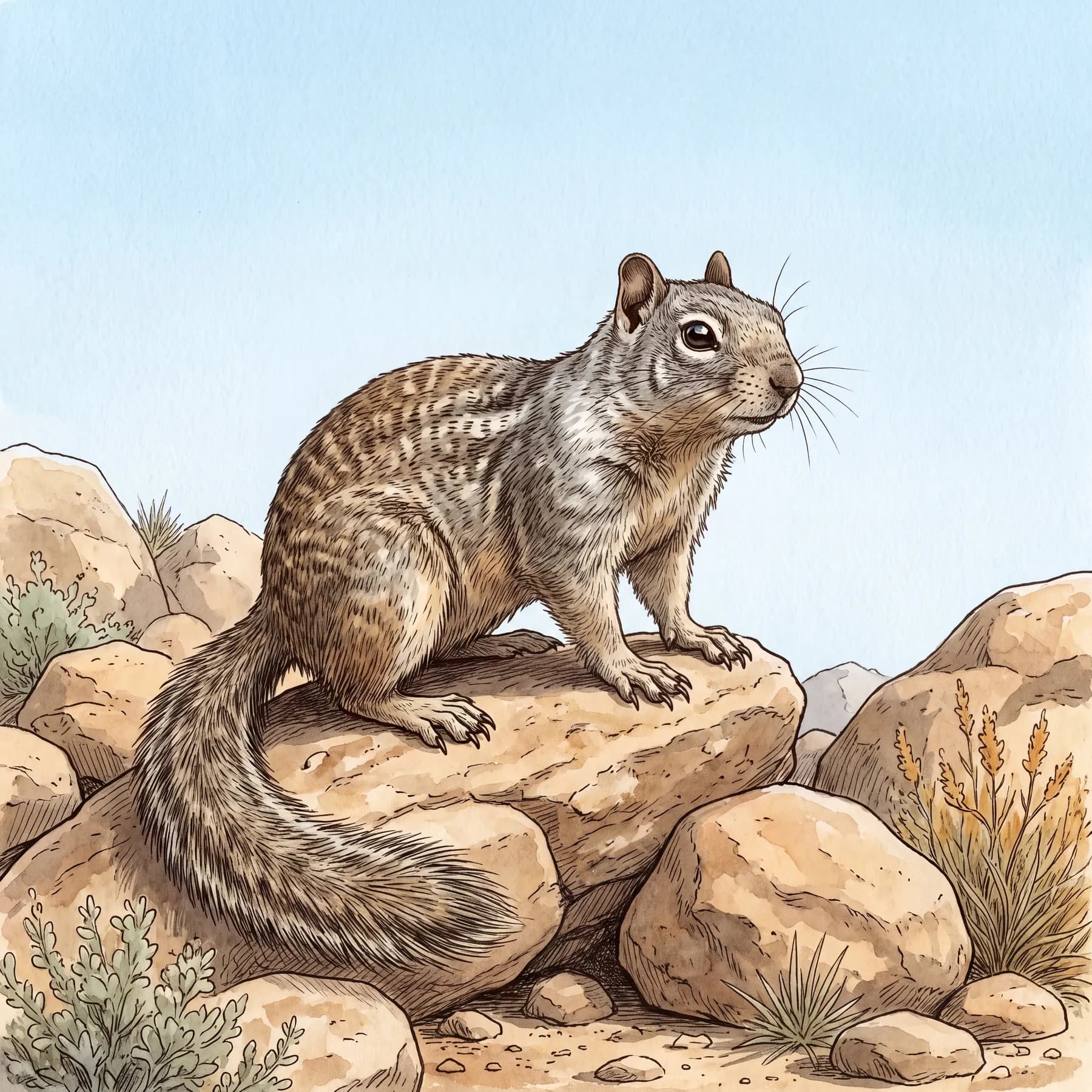
A rock squirrel does not always run from a rattlesnake. Researchers have watched it face the snake instead, waving its tail in stiff flags, kicking sand and grit toward its head, sometimes rushing it outright. A small rodent crowds a venomous predator rather than flee it. The obvious question is how the squirrel gets away with that.
Part of the answer is in its blood. The rock squirrel's serum carries proteins that blunt rattlesnake venom, and the effect is not general. When Biardi and Coss tested it in 2011, the serum weakened the venom of the rattlesnakes the squirrel lives alongside, the western diamondback and the prairie rattlesnake, more than it weakened the venom of a California rattlesnake the animal never meets. The defense is tuned to the neighbors. Against a stranger's venom it does less.
That makes resistance sound like the whole story, and it is not. Owings and his colleagues compared squirrels from wild country with squirrels living around people and found the same blood chemistry in both. What differed was skill. Only the wilderness animals reliably told a rattlesnake from a harmless gopher snake and matched their response to which one they faced. The chemistry is inherited. The judgment is learned, and a squirrel raised without snakes carries the armor without the training to use it.
It helps to know which squirrel this is, because it is easy to confuse. The rock squirrel shares its genus with the California ground squirrel, its better-known cousin. The trick often attributed to rock squirrels, heating the tail so a snake reads it as a warning in infrared, belongs to that cousin and not to this animal. What the rock squirrel brings to a snake is the flagging, the thrown dirt, and the local blood.
A second mechanism has nothing to do with snakes at all. The rock squirrel's winter coat lets in close to a fifth more of the sun's heat than its summer coat does, at the same color, a difference Walsberg and Schmidt measured in 1989. The animal re-tunes the optics of its own fur by season, pulling in solar heat during the cold months and shedding it once the desert turns punishing. One grey squirrel, two ways of handling the sun.
It belongs on this bajada without much doubt. Its range runs from near sea level to about 9,500 feet through rocky desert and canyon across Arizona, so a parcel in the Joshua-tree country sits well inside it. Carry one caution with that fondness: rock squirrels and their fleas are the leading identified flea source of Southwestern human plague, 72.7 percent of the flea-linked cases across a 1957 to 2004 dataset. Reason to watch the animal at a distance, not to handle it. Still nothing of our own here.
On the rocks, look for the squirrel you would otherwise miss: dappled grey, long bushy tail, mottled and never striped.