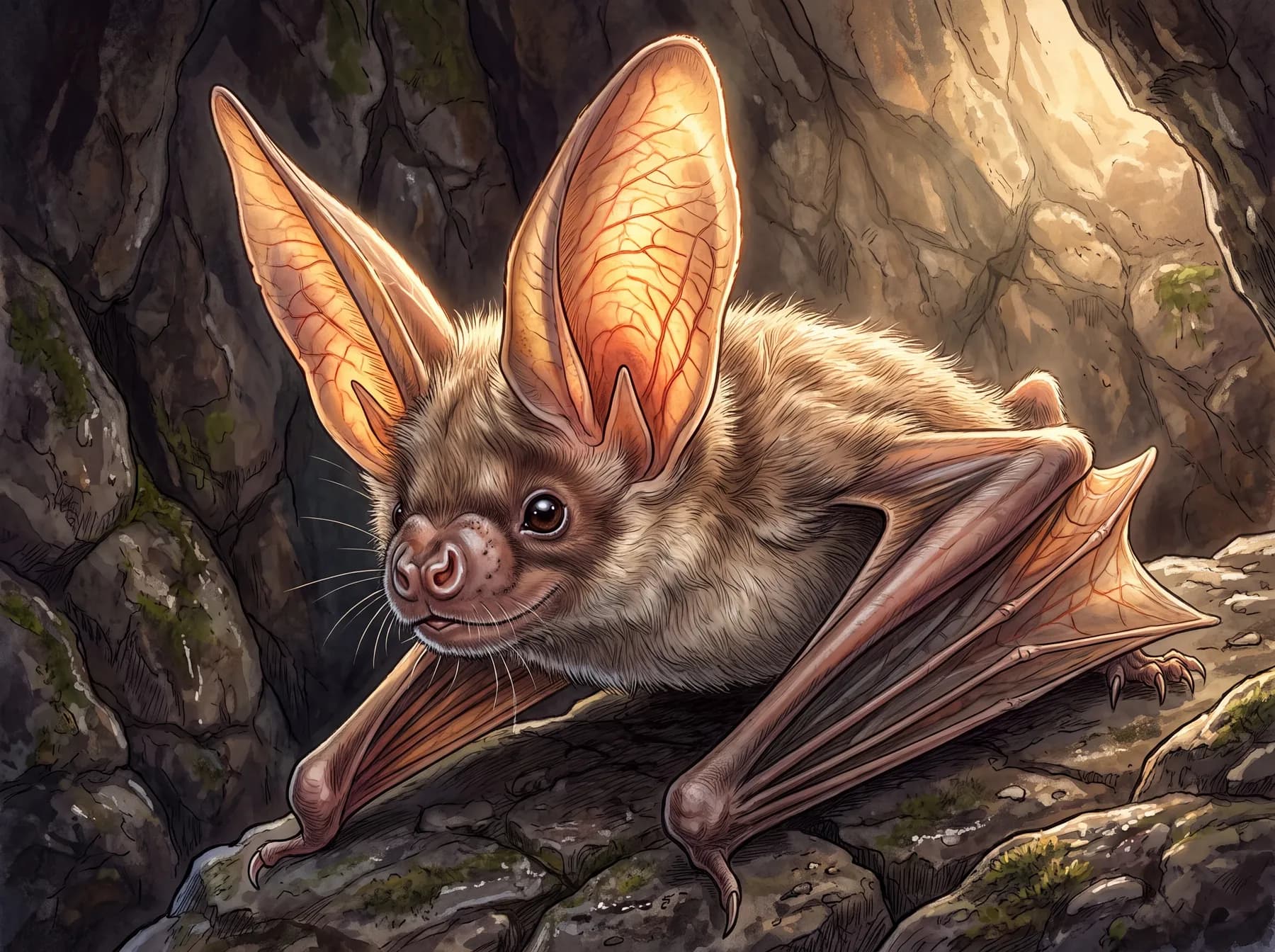
If a bat is hunting moths overhead here, this is the one that would do it in a whisper. Many desert moths carry ears tuned to the sonar of bats. The Townsend's big-eared bat gets around that by turning its own voice down. Its echolocation is faint enough that a moth never hears it coming, which lets the bat pluck the moth straight off a leaf or a rock face rather than chase it through open sky.
The trick is written on the animal's head. The ears are enormous, roughly two-thirds the length of the head and body together, and at rest they coil back along the neck into tight ram's-horn curls. In flight they swing forward like a pair of radar dishes. The eyes stay small. The ears carry the work, because finding a motionless moth by the echo of a quiet call is listening of a very hard kind.
Older field descriptions oversold even that. They said the ears ran nearly the length of the body, which turns out to be too generous; the measured figure is about two-thirds of the head and body. That is still worth getting right, since the ears are the whole reason to look twice.
The desert form is a pale cinnamon, and this dry high country is the kind of place it belongs. We haven't proven one on this ground. The trouble is that confirming it is close to self-defeating. This is a famously nervous species: a single visit to a nursery roost can make the entire colony abandon it. The surest way to prove the bat is here, by finding where it sleeps, is also the surest way to drive it off. That, not paperwork, is why it is carried as a sensitive species across the agencies that manage the surrounding land.
So the honest way to know it is at arm's length or further. If a bat turns up on a camera, or in a hand during a rescue, the face settles it: small eyes, those coiled ears, and two fleshy lumps set one on each side of the snout. Nothing else here wears that combination. The lumps and the ears together are the identification; the pale cinnamon confirms the desert race.
The hunt makes no sound. The whole point of the animal is a call too quiet for its prey, or you, to catch.