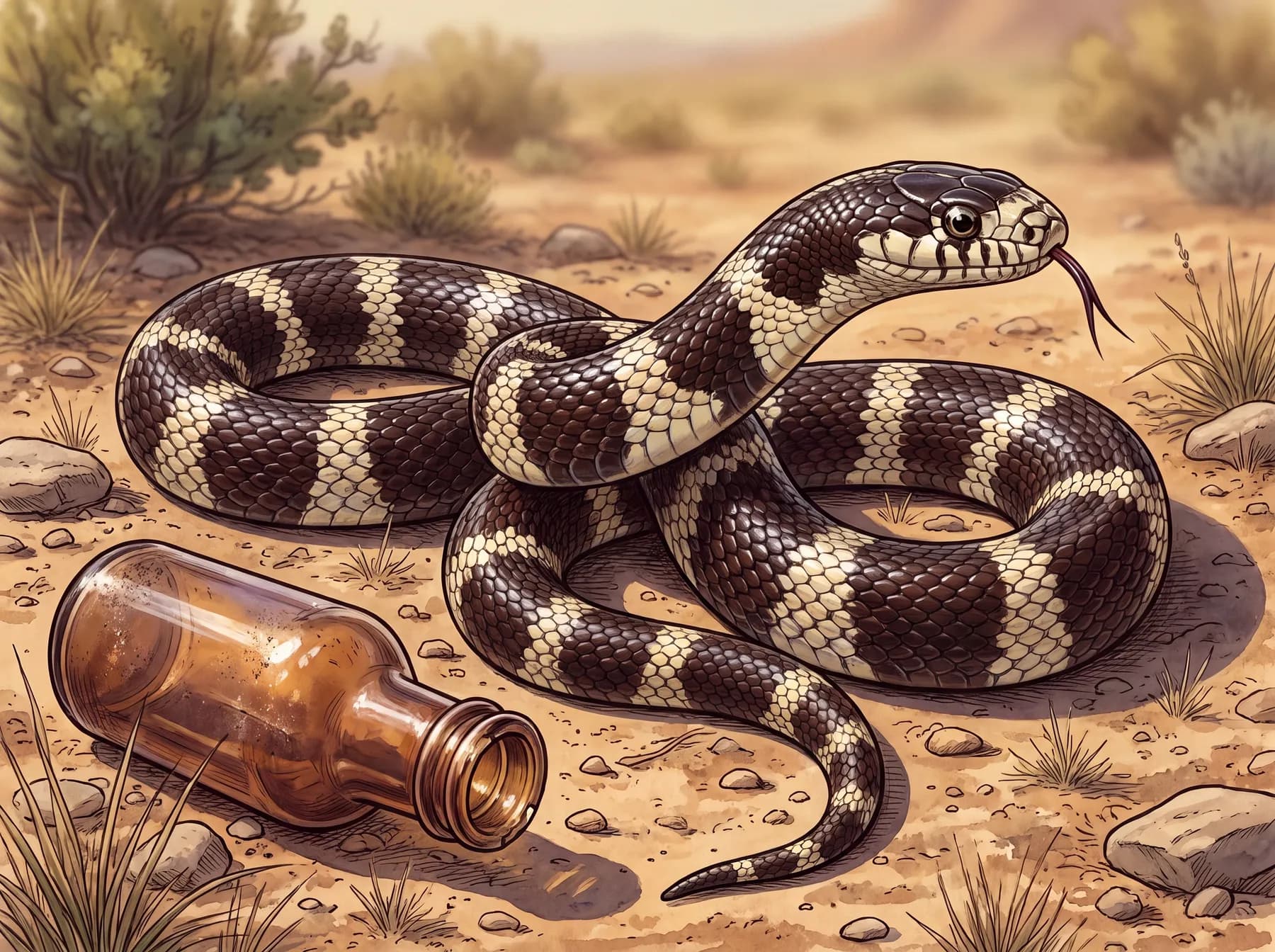
A kingsnake will kill and swallow a rattlesnake that outweighs it, and it does the job with a body that seldom passes four feet. Most are two and a half to three and a half feet of smooth, glossy, banded snake, black and cream, with a rounded pupil, no rattle, and no heat pits: a harmless colubrid that happens to hunt the most dangerous snakes on this ground. The trick is not size. It is strength, and a chemistry in the blood.
Pound for pound, it may be the hardest-squeezing snake anyone has put a gauge on. Measuring constriction pressure across 182 snakes of six species, researchers found the kingsnakes clamped down at around 180 mm Hg, roughly twice the pressure same-size ratsnakes could manage, and harder for their weight than even the pythons in the study. The animals on the bench were the eastern kingsnake, a close cousin split from our western one, so read that as kingsnakes in general rather than a reading of this exact species. Either way, the squeeze does not smother the prey the way older textbooks taught. A tight coil collapses blood flow and the animal goes unconscious in seconds. The precise timing behind that correction was clocked in boas, not kingsnakes, so hold the seconds loosely; the mechanism, circulatory arrest rather than suffocation, is what carries across.
The chemistry is the other half. A kingsnake can take a defensive bite mid-fight and keep working, because its blood carries serum proteins that bind and neutralize pit-viper venom. This is resistance, not immunity, and it is narrower than it sounds. The protection is tuned to the rattlesnakes, copperheads, and cottonmouths the animal evolved beside, and it falls apart outside that group: against coral-snake venom, from a different family, kingsnake serum tests at roughly zero. Here again the strong data come from the eastern cousin. The exact molecules have not been fully pinned down, though venom-injected mice plainly survive better when dosed with kingsnake blood, so it is not the total black box it is sometimes called.
That matters on this bajada, because the resistance is local by design and the local vipers are not a tidy set. A parcel in the upper Mojave sits well inside the kingsnake's range, which reaches about 7,100 feet, so the Joshua-tree flats are no stretch. The rattlesnakes it would meet here run to the western diamondback, the sidewinder, the speckled, and the Mojave rattlesnake. That last one is the catch: the Mojave's venom is often heavily neurotoxic, a class the resistance work did not clearly cover, and nobody has tested this western kingsnake against it. So the snake that eats rattlesnakes is not armored against every rattlesnake here, and immune to none of them.
The rattlesnake appears to know the danger and keeps a special answer for it. Catch the scent of a kingsnake and a rattler will not coil and rattle the way it would for you. It presses its head flat to the ground, where a kingsnake starts swallowing, and lifts the middle of its body into a raised arch to shove the attacker off. It is a move rattlesnakes save for snake-eaters, and against a hungry kingsnake it does not work. We have not turned one up on this ground yet.
Look for the shine: alternating dark and pale bands on a snake too glossy to be a viper, and no rattle at the tail.