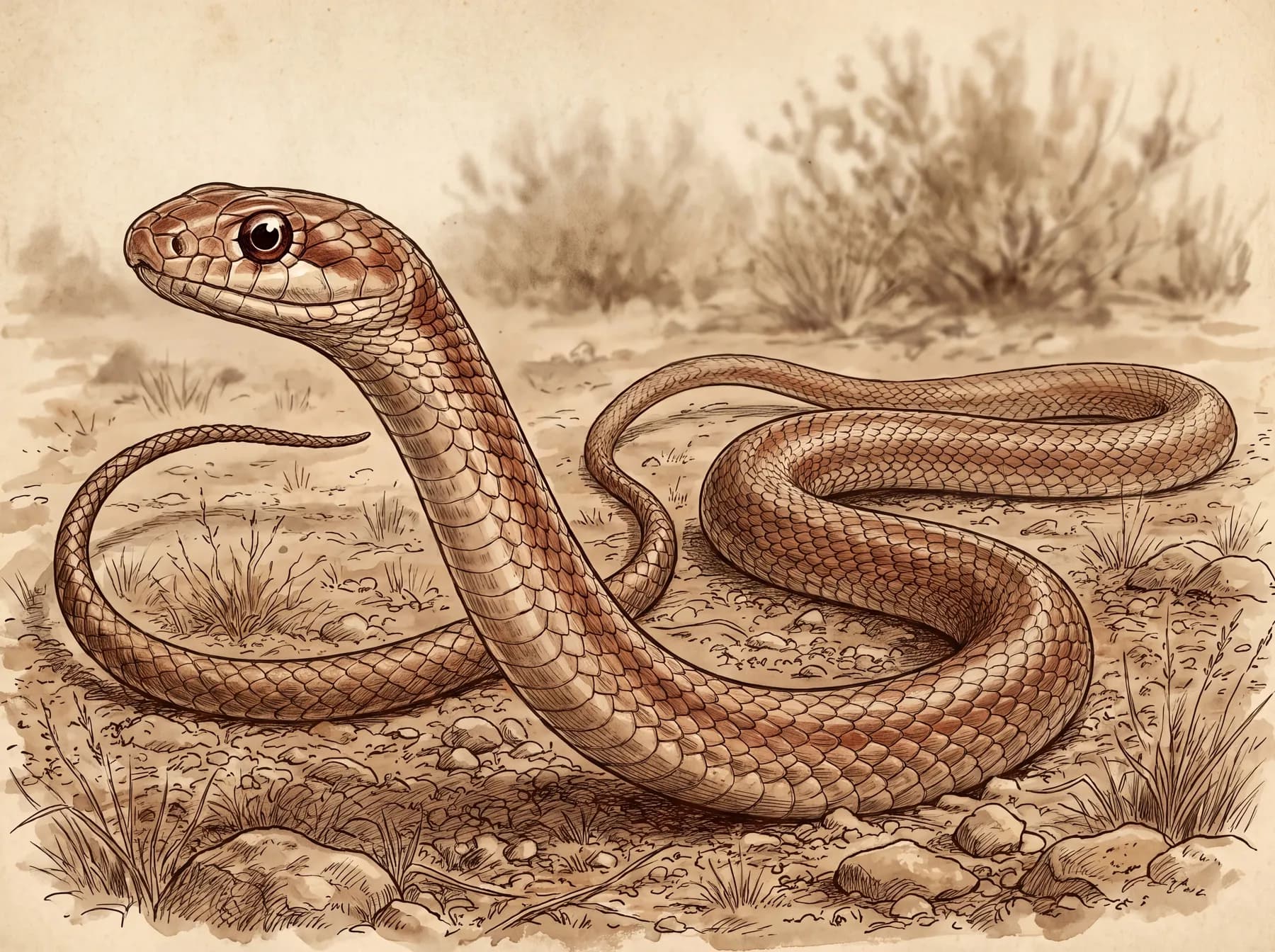
Most snakes on this bajada hunt by holding still. The coachwhip does the opposite, and you can see it doing it: a long, whip-thin snake moving through blackbrush in full daylight with its head lifted clear of the ground, swinging it slowly from side to side. It is a visual hunter with large eyes, reading the open country the way a periscope reads the surface, and it goes looking for prey rather than waiting for prey to arrive.
That choice has a price, and the price is paid every day. Researchers working in the Mojave contrasted this widely-foraging snake against the sidewinder, a sit-and-wait ambusher, and the difference shows up in how much ground each one covers. A coachwhip's home range here runs about 58 hectares, roughly 143 acres, against a sidewinder's 23, and the sidewinder already owns the largest range of any rattlesnake. Going looking costs more energy and exposes the snake to more of whatever might eat it. The wide-foraging strategy is not free; it is a bill.
Which raises the question of how a cold-blooded animal affords to be out working at all. Part of the answer is a trick worth knowing: the coachwhip heats the hunting end first. Using telemetry, researchers found that in this red desert subspecies the head ran significantly hotter than the stomach throughout the day, and warmer even before the snake came out in the morning. It manages that by angling its skull into the sun and into the warmer pockets of its burrow, heating the eyes and brain it hunts with before the rest of it is up to temperature.
This is the "red racer," and the racing carries a long tail of stories: that it will run a person down and flog them with its own tail, that two work together as a pair, the hoop snake that takes its tail in its mouth and rolls downhill after you. None of it is true. The stranger fact is that nobody has properly measured how fast a coachwhip actually goes; the figure passed around online has no study under it. For scale, the fastest land snake on record, the black mamba, manages something like 10 to 12 miles an hour in short bursts. That is a brisk jog. You can outwalk every snake on this continent, and the record-holder is not even one of ours.
It is not venomous, and it does not constrict. It runs down lizards, small mammals, birds, and other snakes — rattlesnakes included — and pins the prey and swallows it alive. If one seems to come at you, it is usually because you are standing between it and the cover it had already picked.
The name is in the tail. The scales along the slender tail overlap in a pattern that looks braided, like the plaited leather of a coachwhip, and the animal is often washed pink or reddish above, which is where the "red racer" comes from.
No confirmed record here yet. Watch the open flats on a warm morning for a lifted head that turns.