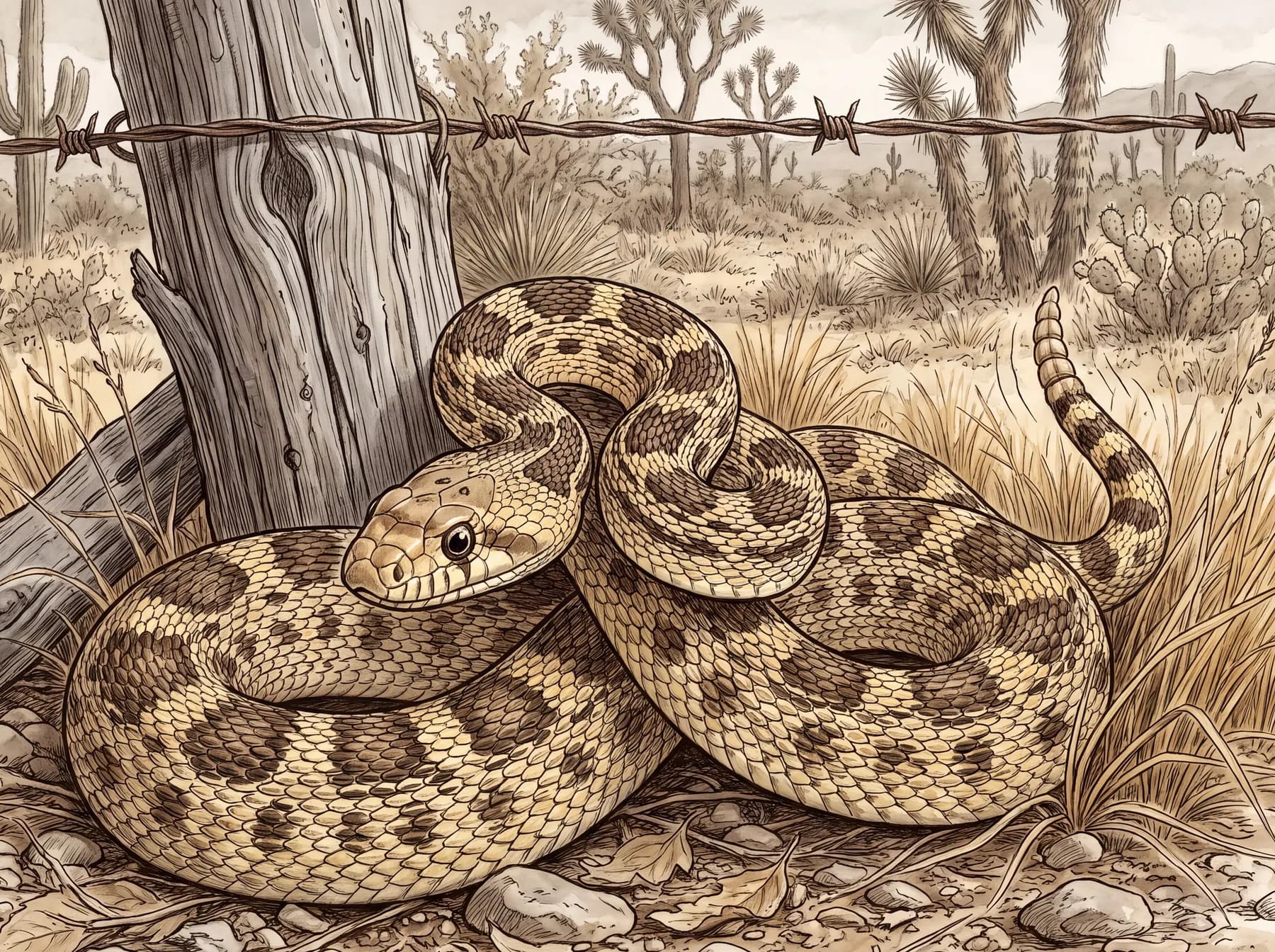
Corner a gopher snake and its defense looks and sounds like a rattlesnake's. It pulls its head back into an S, hisses hard enough to hear across a still yard, flattens and broadens that head until the narrow shape briefly reads as triangular, and vibrates its tail fast against the ground. In dry leaves or gravel that tail throws a dry buzz. The display is convincing enough that the animal is regularly killed for a rattlesnake it isn't.
The tidy reading is that the snake copied the rattler, a harmless animal borrowing a dangerous one's warning. Followed closely, the story runs the other way. When researchers measured defensive tail-vibration across 56 snake species, 155 animals in all, they found it near-universal in the vipers and common in the nonvenomous colubrids the gopher snake belongs to. Both lineages already shook their tails. The rattle looks less like an invention the gopher snake imitated than an elaboration of a behavior both kinds of snake inherited. The buzz is probably older than the rattle.
That does not quite close the case. Gopher snakes living on islands that lack rattlesnakes vibrate their tails for shorter stretches than mainland snakes do, which reads as the bluff fading where the model rattlesnake is absent. So both accounts stay alive: an old, widely shared defensive habit, and a mimicry still under some pressure from the rattlesnake next door. It is worth holding both rather than picking the neater one.
The hiss has its own oddity. Studied in 1995, the sound turned out to come from a flexible shelf of tissue in the snake's voice box — a laryngeal septum, and the first vocal cord ever described in any snake. Remove it in the lab and the harmonic part of the hiss disappears, leaving only moving air. It is still the only such structure described in a snake. An animal most people assume is silent is running breath across a vocal cord to make that warning.
What earns it a place on this bajada is what it does when it isn't bluffing. It is a powerful constrictor, and pocket gophers are particularly significant to its diet; it will follow one down into its own burrow to take it. This ground is squarely its country, since the species is most abundant on foothills, bajadas, and flats below about 6,000 feet. The one here is most likely the Great Basin gopher snake. Forget the record while you are at it: Arizona's longest snake reaches 92 inches, but the animals on this kind of ground are most often under five feet. The tell you want is the tail, not the pupil — a plain point tapering off, carrying no rattle, buzzing only because it is pressed to dry ground.
So before the shovel comes down, look at the tail: a point, not a rattle, buzzing a warning it inherited long before the rattlesnake did.