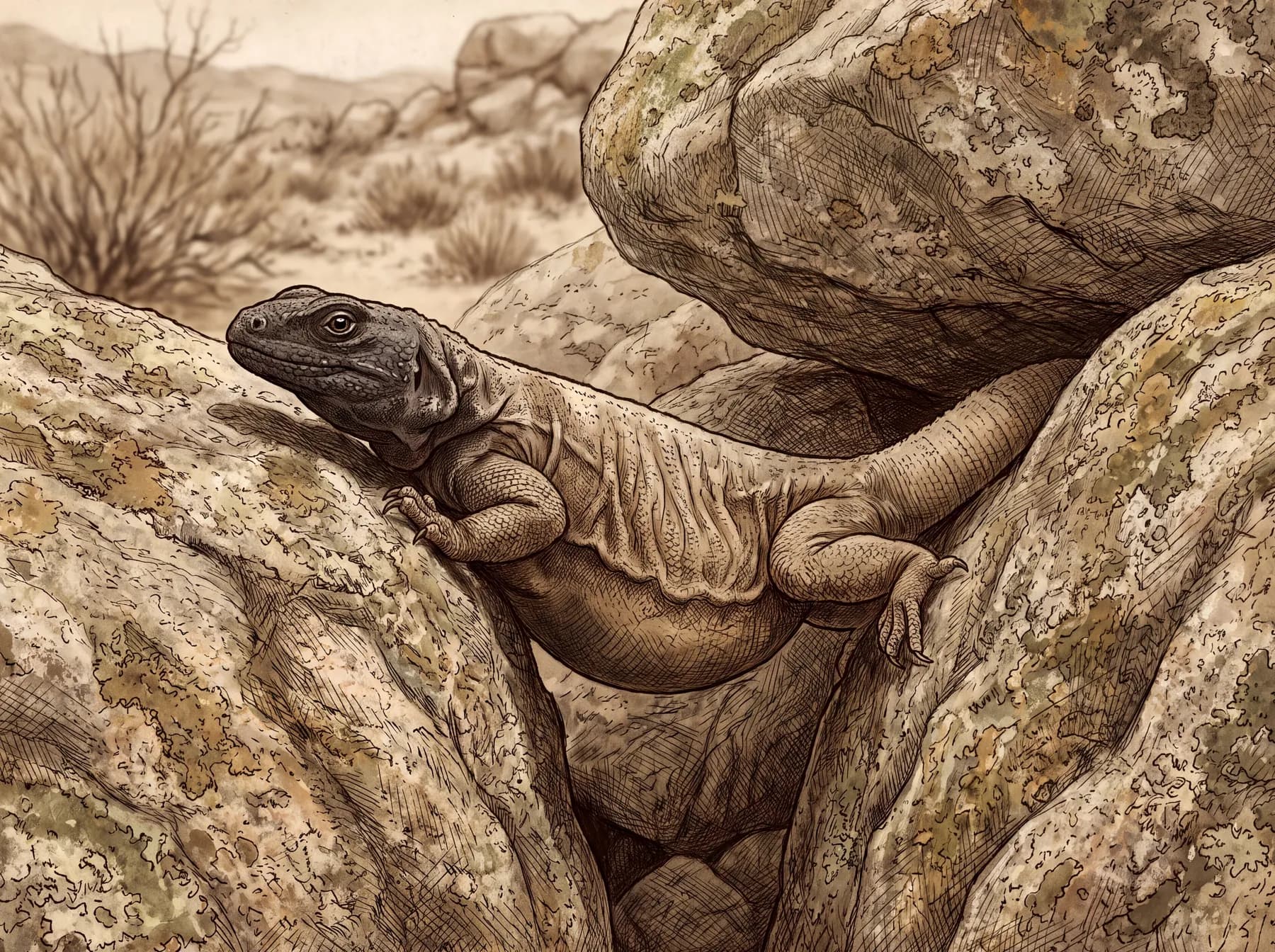
Corner a chuckwalla and it does the opposite of run. It waddles into the nearest rock crevice, gulps air until its body swells against the stone, and turns itself into a cork you cannot pull out. For a slow, loose-skinned, almost entirely vegetarian lizard, it is a strange and very good trick, and researchers have taken it apart carefully enough to explain how it works.
The pump is the throat. A threatened chuckwalla wedges into the crack and forces air into its lungs, inflating them to as much as four times their normal filled volume until the baggy folds of skin along its neck and flanks stretch tight against the rock. In one study the pressure inside a wedged animal reached 260 millimeters of water, against 120 for an animal inflating in the open, more than twice as much. Prop its mouth open with a wooden dowel and the whole thing fails: not one animal in that experiment could inflate while it strained and worked its throat, because the mouth and nostrils both have to seal before the throat can build any pressure at all.
There is a tell in the sound, or rather in the lack of it. In the open a cornered chuckwalla hisses; wedged into the rock it goes quiet, and the silence is not shyness. A hiss vents the lungs, and venting the lungs would drain the very pressure holding it in place, so it keeps its mouth shut and stays swollen. It grips with its claws as well, and no one has measured how much of the anchor is air and how much is claw.
"Impossible to pull out" is the wrong lesson. Desert peoples hunted chuckwallas for food and long ago learned the counter: a barbed hook, first of bone and later of wire, thrust into the crevice to puncture the inflated lung. Once the air was out, the deflated lizard came free.
Worth knowing on sight, because on this bajada it is expected and not yet confirmed. The chuckwalla is the second-largest lizard native to the United States, after the Gila monster, a broad, flat, pot-bellied animal up to about twenty inches long and two pounds, with loose skin and a blunt, wide-based tail. It eats leaves, flowers, and fruit, takes most of its water straight from that green forage, and dumps the leftover minerals through a gland in its nose, so a caught animal often has its snout crusted white with mostly potassium rather than the sodium of table salt. The one thing it will not do is live out on the open flats. It needs crevices, so it holds to rock: boulder piles, lava flows, broken outcrops. The climate here suits it well enough; what decides whether it is present is whether there is rock to wedge into.
Look for it where the ground turns to stone, not sand: a white-crusted snout in a crevice, and a lizard you cannot budge.