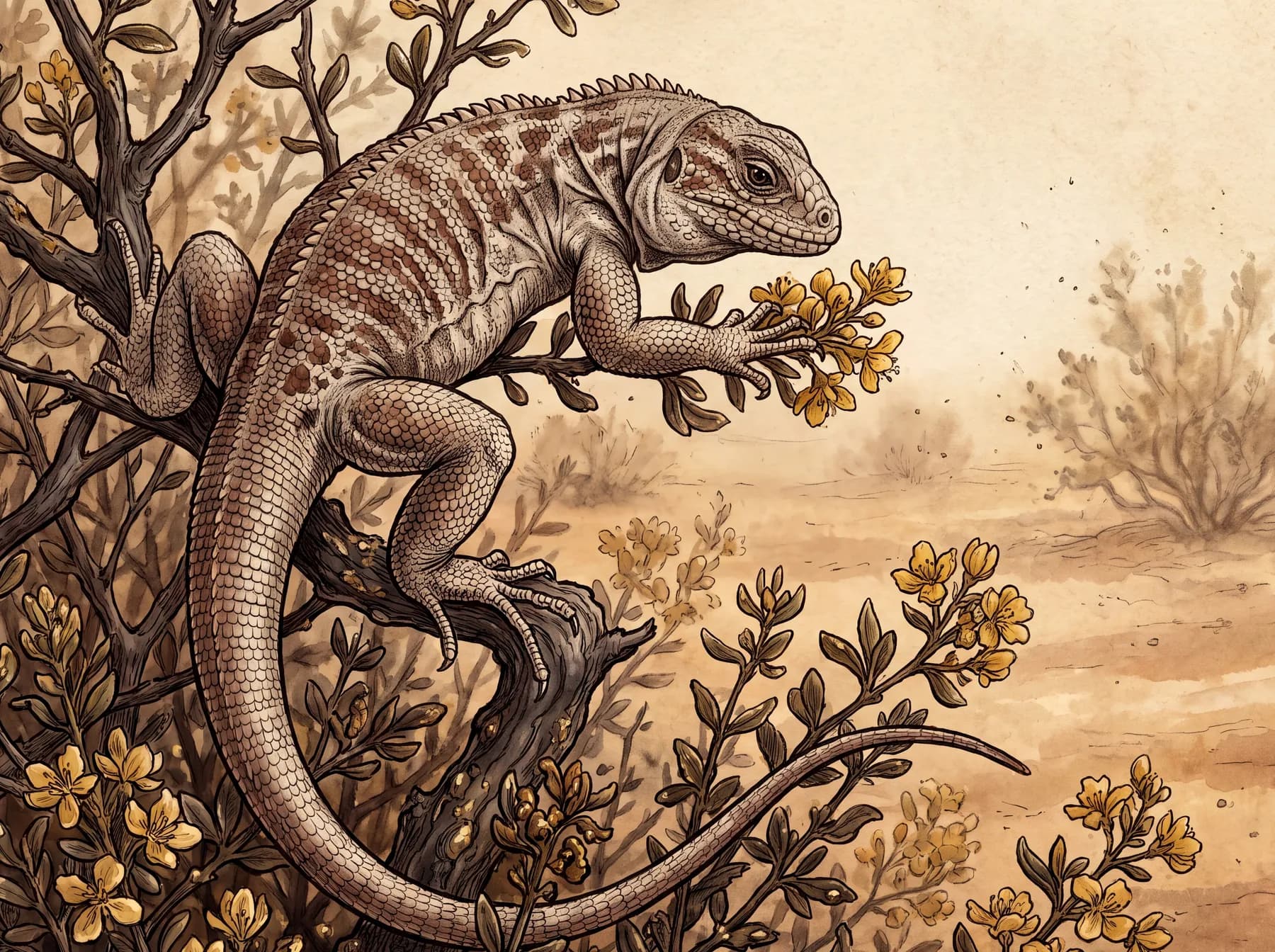
The evidence that a fever is a defense, and not just damage, was largely worked out in a lizard, and it more or less had to be this one. A desert iguana runs hot on purpose. Its preferred working body temperature is around 40°C, about 104°F, higher than almost any lizard on the continent holds, and it tolerates more heat than any other North American reptile before the heat turns lethal. A mammal cannot volunteer for a fever; it is stuck with the thermostat evolution handed it. A lizard can walk to a hotter spot and hold itself there, which means you can watch it choose.
In 1975 a team infected desert iguanas with live bacteria and gave them a gradient of temperatures to move through. The sick animals allowed to reach the warm end and raise their body temperature survived at markedly higher rates than those kept cool. A later experiment sharpened it. Injected iguanas pushed their temperature up about 2.7°C, and when researchers blocked that rise with an antipyretic drug, the outcome divided cleanly. Of twelve infected and dosed, the five that still mounted a fever lived out the week, and the seven that could not were dead within three days.
That result travels a long way past lizards. It became a foundational piece of the case that fever is an old, shared, adaptive response rather than the body simply running hot under strain, a case that reaches into us. The iguana could carry the experiment because it does willingly and safely what a fever asks. It reaches high temperatures and holds them. Its measured ceiling sits near 47.5°C, roughly 117°F, the highest thermal tolerance recorded in a North American lizard, and it only begins panting to shed heat around 43 to 44°C. There is a molecular backstop underneath the behavior, too: the heat-shock proteins that refold other proteins as heat starts to pull them apart run at a baseline tuned upward in the hottest desert lizards, this one among them.
For all that tolerance, it makes an unexpected living. More than 90 percent of its diet is plant matter, buds and leaves and flowers, and in spring it favors yellow blossoms, especially those of the creosote bush, whose resins deter most other browsers. It will climb a metre up into the shrub to reach them. The tie is close enough that the lizard's whole range tracks the creosote's across the Mojave and Sonoran deserts.
Which is why it sits uneasily on this ground. The desert iguana is a creosote-flat specialist, most abundant on lower, sandy flats thick with the shrub. This bajada, in Joshua tree and blackbrush, is not that. The elevation itself is no barrier; the species is documented well above this, up toward 4,000 or 5,000 feet depending on the source. The habitat is the barrier. This is the thin upper edge of where you would expect it, a creosote lizard in country a little too high and too mixed to be its best. Not confirmed here, and perhaps we never will.
If one does turn up, it will read pale, almost whitish against the sand, a robust round-bodied lizard with a small blunt nose, a low crest of keeled scales down the back, and a thick tail, longer than its body, ringed with dark toward the tip.
Check the creosote in spring: this one climbs into the shrub for the yellow flowers, a field mark as good as its pale color.