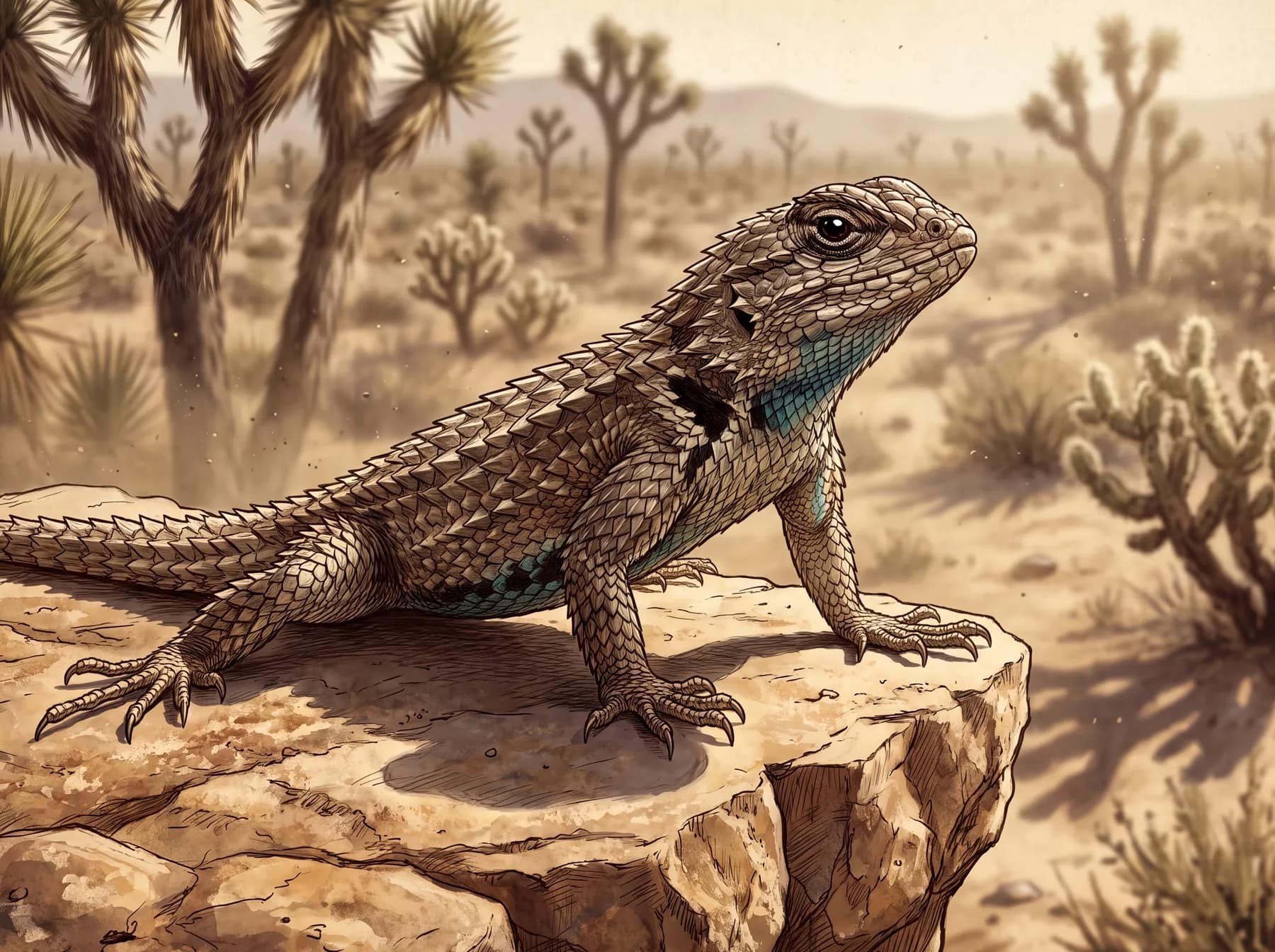
On top of a desert spiny lizard's head, set between the two eyes you can see, there is a third. It is small and pale, and sensitive to light. It is closer to a light meter than an eye, and on this lizard it turned out to be part of a thermostat.
The proof is unusually direct, because it was run on this exact species and not a cousin. In a 1976 study, researchers removed that parietal eye from desert spiny lizards and let them pick their own temperature against untouched controls. The controls settled around a preferred body temperature of 33.2 degrees C. The lizards missing the parietal eye chose to run significantly hotter. Take away the sensor and the animal loses its ceiling: the third eye is part of how it caps how hot it will let itself get, and how it keeps its daily rhythm tied to the length of the day.
That matters because a spiny lizard has few other ways to manage heat. It has almost no way to shed heat but to move. So it spends the day shuttling. It is out and diurnal, working conspicuous raised perches, a rock or a yucca or the low arm of a Joshua tree, to forage and to signal, then retreating into cover through the worst of the midday sun rather than cooking on the perch. The body is the thermostat, and it has no dial but the whole animal.
This is squarely a resident's animal. The desert spiny lizard's range covers the Mojave and runs from near sea level up past 5,000 feet, by some accounts to about 7,000, so this bajada sits comfortably inside it. Where the habitat suits them they are not scarce, either: creosote flats have been found to hold somewhere between 2 and 20 of them per acre. We've yet to log one on this ground, but few lizards here would be easier to expect.
There is a wrinkle in even naming it. The old single species was split, and the spiny lizards of the Mojave and Great Basin are now often assigned to a segregate, the yellow-backed form. At this elevation the animal on the fence post may technically belong to that split-off, though field guides and most people still call it a desert spiny lizard. Without a local record in hand, that is as far as the identification honestly goes.
The males carry the loudest field mark, and it stays hidden until they choose to show it. A male wears two patches of bright blue-green low on the belly and another at the throat; females and young have none of it. Spiny lizards flash that color and run push-up displays at rivals, and researchers separate a low-key version given to no audience from a harder one aimed at a real intruder. What the blue advertises is less settled than it looks: when two other spiny lizards were tested, belly color and body condition did not predict who held the ground.
Up close, the build is the giveaway. The scales are large, pointed, and keeled, overlapping like filed metal, and a big one runs to about 5.6 inches from snout to vent, heavy-bodied for its kind. Behind the head, a black wedge crosses each shoulder.
Look on a warm rock, outside the midday heat, for that black shoulder wedge, and on a male the hidden belly blue.