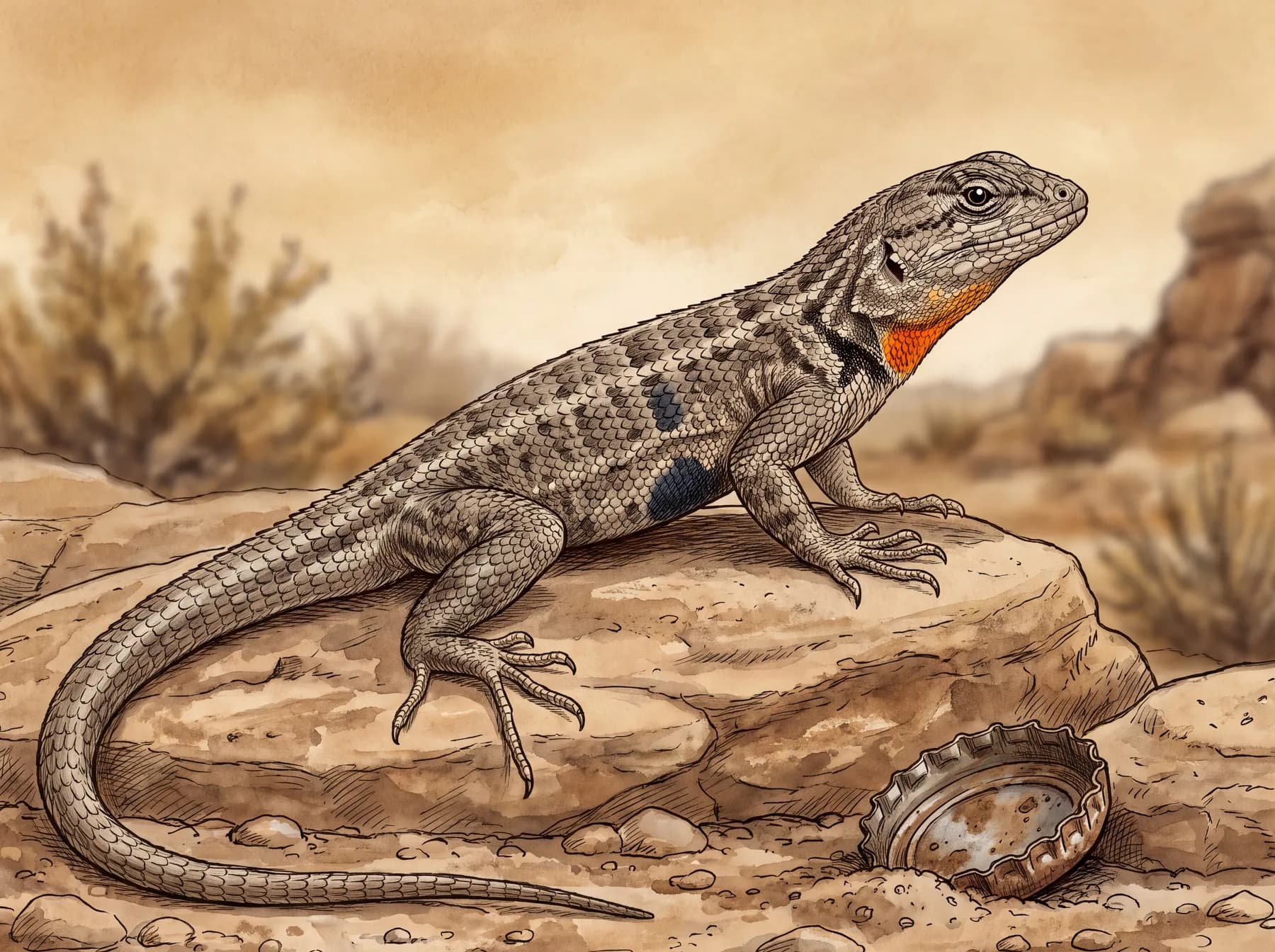
The males come in three throat colors, and each color is a different way of being male. An orange-throated male holds a large territory by force and keeps several females inside it. A blue-throated male holds a small patch and guards one female closely. A yellow-throated male holds no ground at all; he looks like a female, and he uses the disguise to slip past the other two and mate. Three tactics, and no clean winner among them. Researchers described the pattern in 1996 and gave it a name most people already know: rock-paper-scissors.
The game turns because each tactic beats one rival and loses to another. Orange overruns blue, its aggression swallowing the small guarder's patch. Blue beats yellow, because a male watching a single female closely catches the sneaker in the act. Yellow beats orange, because an orange male holding too much ground cannot watch every female on it, so the disguised sneaker gets through. Orange to blue to yellow to orange, and around again.
For thirty years the textbook read that as three strategies written into three genes. A whole-genome study published in 2026 sequenced wild lizards of all three colors, and the neat version came apart. The colors run on two genetic variants, not three, at a single gene. Orange is one genotype. Blue and yellow are the same genotype, the yellow simply expressed differently — a bluff thrown from the blue hand, not a card of its own. When the researchers simulated the old three-gene model it kept losing a color and collapsing, failing in about 91 percent of runs, while the two-variant version held every time. The biologist who first described the game in 1996 was an author on the paper that corrected it. The game is real. It just runs on two cards and a bluff.
None of this is rare or far away. Where it is common the side-blotched lizard is often the most abundant reptile on the ground, reaching hundreds to the acre, and this dry Joshua-tree and blackbrush flat is exactly its country. You have probably walked past a dozen without looking down. It can afford the crowd because it is cheap to run and quick to turn over: a small insectivore that lives one to two years in the wild, lays several small clutches a season, and mostly does not reach a second year. In one long capture study, only about 12 percent of the lizards caught as yearlings were ever found again in a later year.
Something else the lizard keeps in its body is worth knowing before you reach for one. Do not take it by the tail. The tail does more than drop and regrow to escape a grip; it carries social standing. Researchers found that removing the tail from a dominant side-blotched lizard lowered its rank in later contests. A dominant animal that loses its tail loses standing with it.
The throat colors are the males' game, and you may never see them. The mark that names the species is quieter and sits on both sexes: a dark blue-gray blotch low on each flank, just behind the front leg.
Look for that blotch behind the foreleg, on a lizard you have almost certainly already walked past.