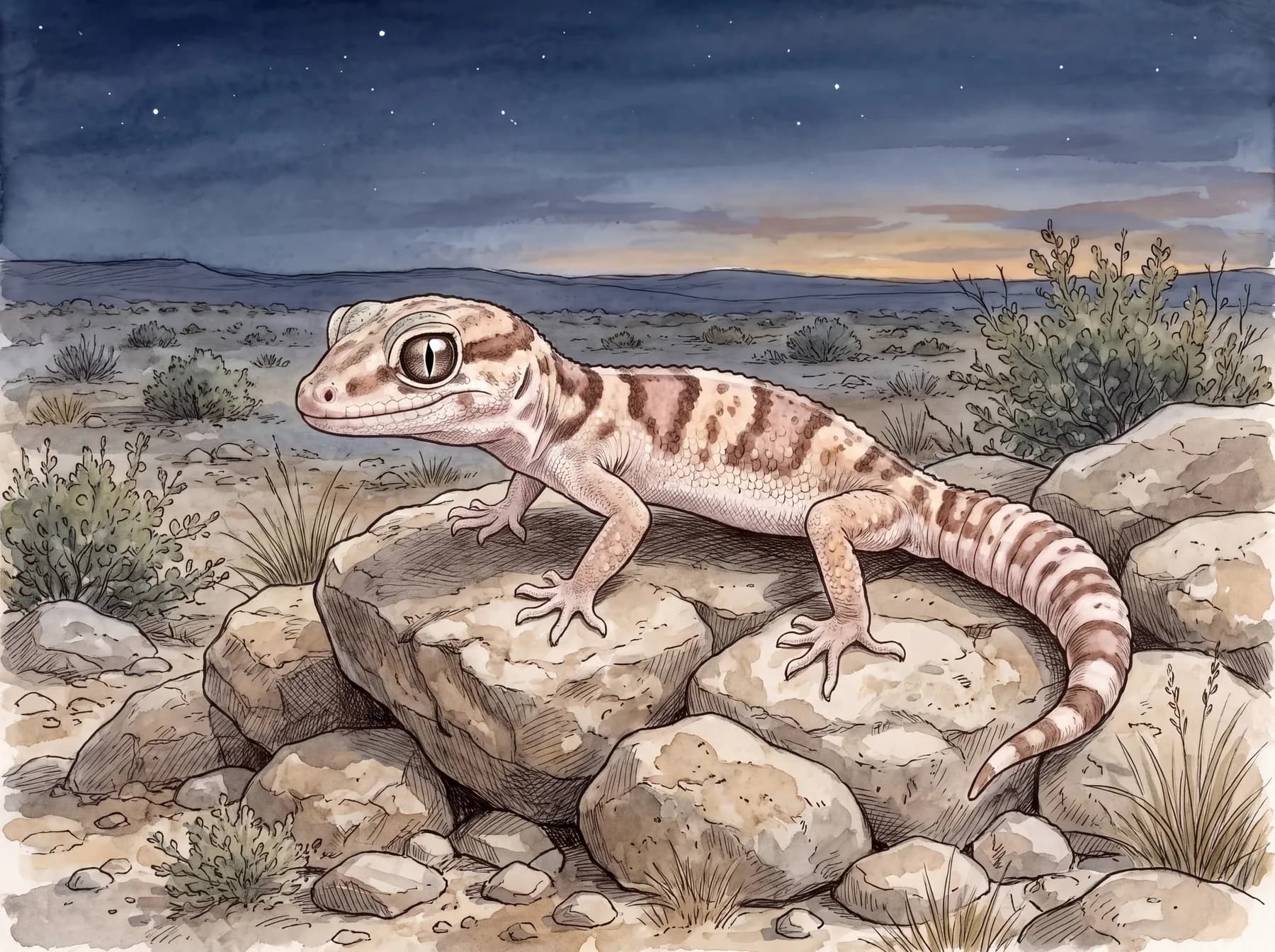
Corner a scorpion with a western banded gecko and the gecko does not circle, or wait, or pick at it from behind. It bites down and starts thrashing, swinging its head so hard and so fast that the scorpion is beaten against the ground on both sides of the stroke. The whole assault is over in a second and a half. It is also, in the ordinary sense, invisible: the researchers who first described it in 2022 had to film at 1,288 frames a second before they could see what the animal was doing.
The engine is the neck. A gecko in mid-shake swings its head from about a hundred degrees on one side, through the middle, to a hundred degrees on the other and back again, and it repeats that roughly thirteen times a second for thirty-one cycles. The scorpion on the end of it is travelling fast enough to matter: the researchers measured the force flinging it outward at about a third of a newton, which is a great deal to ask of an animal you could rest on two fingers.
The shaking is reserved. Offered a cricket, an antlion, or a sand roach, the same geckos shook five times or could not be bothered at all, and only three of ten prey items got shaken. Every single scorpion did, all twenty-one of them. The commitment shows earlier than that, too: a gecko going after a scorpion launches from further away and strikes faster than the same animal going after something harmless, as though it has decided the thing is worth a running start.
Why the beating works is still open. It may cause enough damage to leave the scorpion unable to move, or it may snap the stinger off, and the people who filmed it say plainly that they do not yet know which. What is certain is that it is not a clean victory. Two thirds of the scorpions stopped moving afterwards. In nineteen of the twenty-one attempts, the gecko was stung. It ate the scorpion anyway. Nor is the trick unique: whiptail lizards do the same violent shaking to scorpions and not to crickets, which suggests this is a solution that arid lizards keep arriving at.
All of which is a lot of animal for something this size. Snout to vent it is two to three inches; four to six with the tail, and about an inch on the day it hatches. The skin is soft and finely granular, closer to suede than to the armour most desert lizards wear, and the eyes have working lids. That last part is rarer than it sounds. Banded geckos belong to the eyelid geckos, a small branch of a family that otherwise cannot blink and cleans its eyes with its tongue. The tail is expendable and it is used that way: raised and waved at a threatening snake to draw the strike away from the body, which works better when the tail is the original one.
Which gives you two things to look for. If it is on a wall, with round lidless eyes, bumpy skin and broad pads on its toes, it is the introduced house gecko. Ours stays on the ground, blinks, and has slim clawed toes with no pads at all. And if the bands on the tail do not line up with the bands on the back, that tail is a replacement, and something has already had hold of it once.
It hunts after dark and goes underground from about November to February. Ours turned up in August.