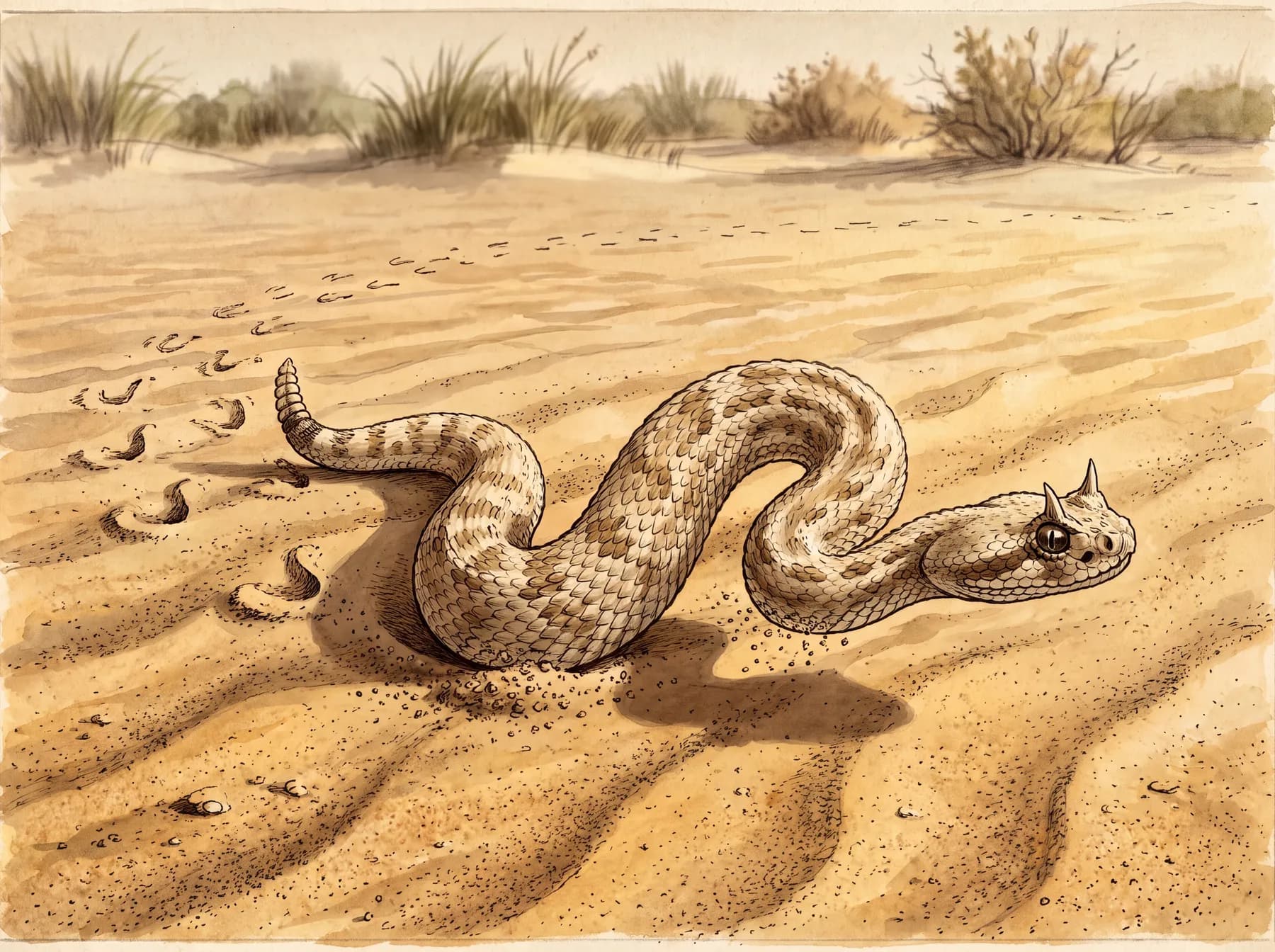
Everyone will tell you the sidewinder throws itself sideways to stay off the hot sand. Heat has something to do with it, but the gait solves an older and plainer problem first: how to walk on a surface that will not hold still under your weight.
Watch what the body actually does. Instead of dragging forward, the snake throws its loops obliquely across the ground and, on flat sand, keeps only two short sections touching at any moment while the rest of it is lifted and rolling ahead. Researchers describe it as two body waves, one horizontal and one vertical, running roughly 90 degrees out of phase, so the animal seems to step over the sand rather than crawl through it. When a team ran real snakes and a snake-shaped robot up sandy slopes, the thing the motion bought was traction: on loose, flowing grains you cannot push against, sidewinding barely slips where an ordinary crawl digs itself in and fails.
The "only two points" picture is the flat-ground version, and it is worth correcting before it hardens into a rule. On a slope the same study found the snake lengthens the stretch of body it lays down, spreading its grip as the sand grows more willing to give way; the robot copying that one adjustment climbed inclines that fixed-gait machines slid back down. The heat story is real but secondary. Touching the ground only briefly, in two small patches, does limit how much warmth a belly picks up crossing open sand at midday. That is a benefit of the gait, not the reason for it.
The animal that does this is small, the smallest rattlesnake in its range, and it carries one feature nothing else here shares: a raised, pointed scale standing over each eye like a horn, able to fold down flat. You will be told the horns shade the eye, or keep sand out, or let a buried snake still see. Each is a reasonable guess, and none has been demonstrated; the purpose is genuinely unsettled.
Whether it reaches this ground at all is a fair question. The sidewinder is a loose-sand specialist, and this is a rocky, gravelly blackbrush bench. An authoritative Arizona source puts the state's sidewinders from the Colorado River up to about 2,800 feet, which sets this parcel just above the documented edge, though the species reaches near 6,000 feet elsewhere in its range. It is not strictly sand-only; it uses hardpan and flats too. So the honest verdict is marginal: possible in the sandy washes, rare, and not something to expect on the hard gravel.
Which is why you are far likelier to read the snake than to see it. Where it crosses loose sand it prints a row of separate, parallel J-shaped bars set at about 45 degrees to its line of travel, the hook of each J pointing the way it went.
Look for that ladder of angled bars in a wash after a still night; the snake that left it was mostly in the air.