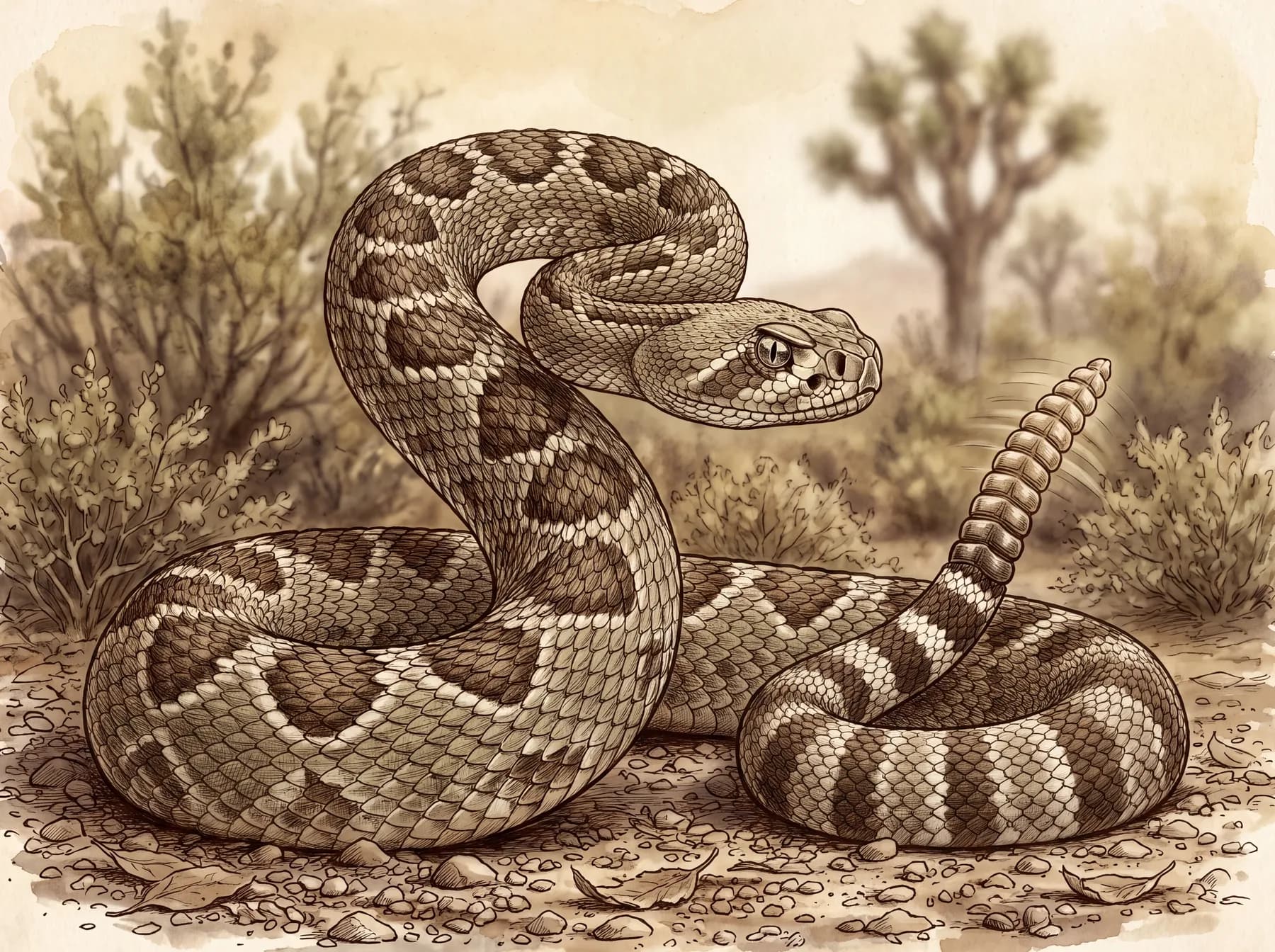
Two snakes share this one name, and they are not the same animal in any way a body would notice. The Mojave rattlesnake carries one of two venoms, and which one depends on where it was born. Across much of its range it makes Type B, a tissue-destroying venom, the ordinary serious kind you would expect from a rattlesnake. On this ground it makes Type A, built around a neurotoxin instead. When researchers characterized the venom across the whole range, all but one snake sampled in the Mojave Desert (California and northwest Arizona) came back Type A. This ground is northwest Arizona.
The arrangement is the strange part. It is not a gradient, one type shading into the other across the map. Populations are nearly fixed for a single venom type, and the split can hold across a few miles inside one continuous, interbreeding population, the fixation staying put on a fine geographic scale despite high gene flow. Something local is selecting hard enough to override all that mixing, valley by valley. The chemistry follows the ground more than the family tree.
Between the two venoms, the difference is not small. Type A is built around Mojave toxin, a presynaptic neurotoxin with little of the tissue-destroying activity a typical rattlesnake bite brings; Type B carries that damage and lacks the neurotoxin. By the standard laboratory measure, mouse LD50, Type A comes in roughly ten times more lethal than Type B, about 0.22 to 0.46 against 2.0 to 6.0 milligrams per kilogram. That is a mouse number and not a human ranking, and it belongs in that lane.
The geography sets a trap. Arizona physicians have published, correctly, that Mojave bites in Arizona are not neurotoxic; the national bite registry logged nine of them and found local swelling in every one and neurological signs in none. The same registry logged neurological effects in nearly half of the California bites. The catch is that those Arizona registry snakes are central- and southern-Arizona animals, which run Type B. The population on this bajada is Type A. A statewide reassurance drawn from the wrong snakes does not describe the animal on this ground.
Timing sets a second trap. Serious signs can lag the bite by hours, and the local wound can look deceptively mild against how bad the systemic picture becomes. One documented patient, an eleven-year-old, was breathing on his own and then needed a tube put back in at the thirty-hour mark, after thirty vials of antivenom. An early-mild bite is not a settled one; it is medically serious whatever it looks like at the start, which is the whole reason to get to care and not wait to be convinced.
For all of that, the animal is not the aggressor of the stories. It is shy and cryptic and would rather leave than spend venom, though it will stand and strike when surprised or cornered, and readier to stand its ground out on the open Joshua-tree and blackbrush flats, where there is no burrow or brush to back into. From a distance you can lean it away from a diamondback by the tail: on a Mojave the pale bands run wider than the dark, close to two to one, and the ring nearest the rattle is usually the light one. That is a tendency, not a test. Experts confuse the two in the hand, and the response would not change either way.
Give it the room. To name it from a distance, read the tail: pale bands wider than dark, a light ring at the rattle.