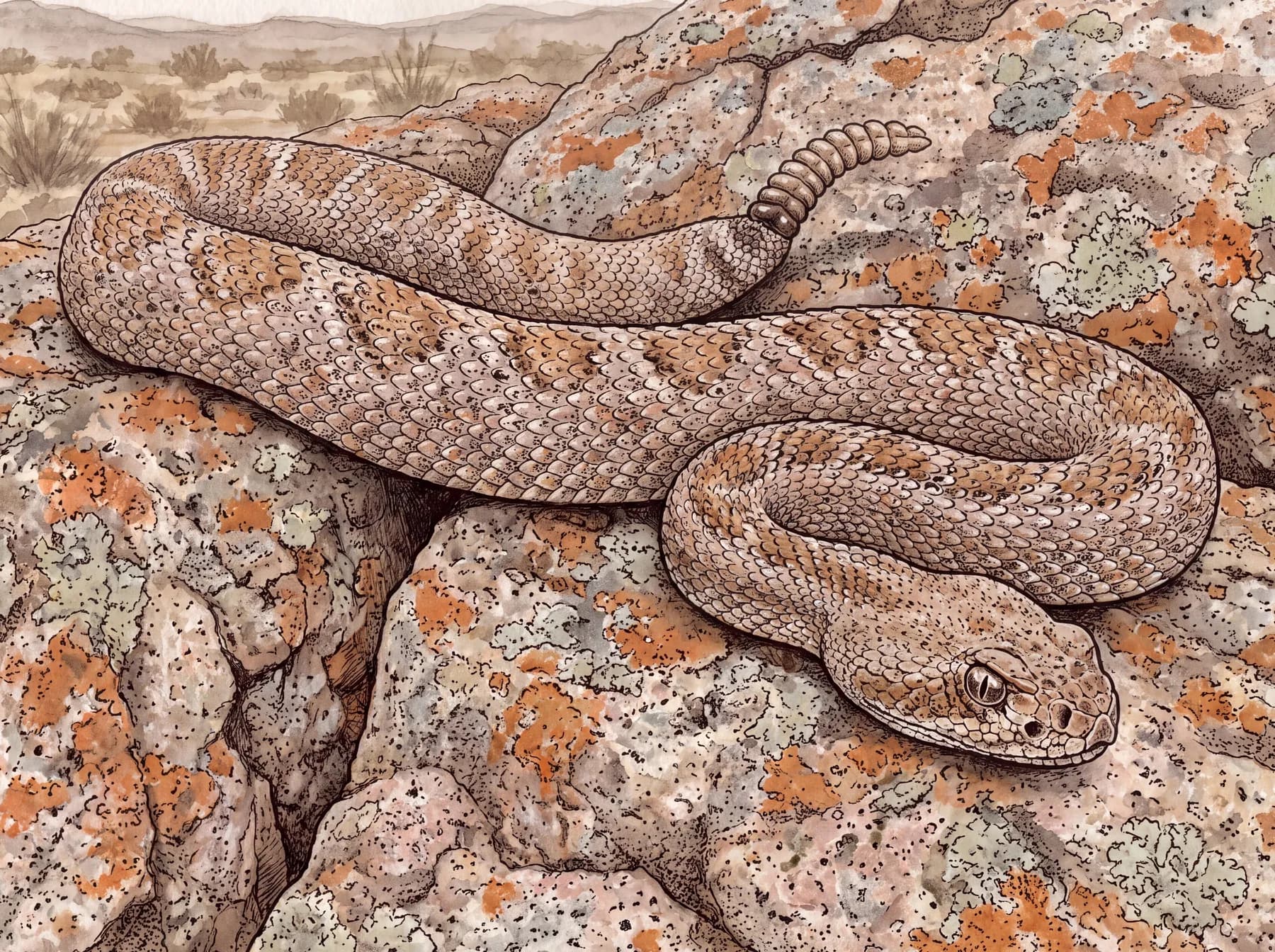
Two speckled rattlesnakes taken from rock a few miles apart can look like two different animals. One is rusty tan; the next is pink, or peach, or a chalky off-white, or a pale blue-gray, everything dusted with the fine black and white flecks that give the snake its name. The color is the honest puzzle here. The snake does not shift to match its background the way a chameleon would, and some individuals do not match the rock at all. What matches, and only often, is the population: pale snakes on pale stone, rusty snakes on rusty stone, a few miles of ground between them.
Even the name is unsettled. For a long time this was treated as a subspecies of Mitchell's rattlesnake. In 2015 a study using DNA and anatomy split that group and raised the southwestern form to a full species, Crotalus pyrrhus. The change is newer than many of the field guides. Arizona's own standard reference still files the animal under the older name, so the snake in these rocks was reclassified more recently than the books on the shelf.
The tidy story writes itself: the snake matches the rock so nothing spots it. It is a good story, and on this snake it has never been tested. The nearest evidence borrows a relative. In 2012 researchers built model snakes out of foam, colored some to match the local rock and some to clash with it, and left them where wild birds could strike; the models that contrasted with the ground drew significantly more attacks than the ones that blended in. But that experiment used the mottled rock rattlesnake, not the speckled.
A later study came closer to catching the behavior itself. Tracking 14 western diamondback rattlesnakes by radio and photographing each where it lay with a camera that sees ultraviolet the way a bird does, researchers found the snakes matched the color, brightness, and pattern of their resting places far better than random spots nearby. They were not doing it for warmth. Body temperature, logged from inside the animals, had no real bearing on the backgrounds they chose. They pick a place to disappear, not a place to bask.
That is the point of all the rock. This is a snake of boulder slopes, steep bajadas, and canyon walls, usually above the flats, and where it does cross open ground it rarely strays far from stone. Its Arizona range covers the western and northwestern counties, Mohave among them, from near the Colorado River up to about 5,000 feet, so this bajada sits comfortably inside it. It hunts by ambush, waiting in a crevice for the small mammals it mostly takes, with birds and lizards behind them, and it moves its working hours with the season: out by day in the cool of spring, then over to the night as summer heat builds, and around the clock when conditions allow.
Its first defense is to do nothing. Trusting the camouflage, a speckled rattlesnake will often lie still and let you walk almost onto it before it reacts. It rattles readily once it does, but a warning is not a thing to count on, and the venom is potent and delivered in quantity, so the distance you keep is the whole of your margin. None confirmed on this ground so far; the rock and the elevation make it a snake to expect, not one we have met.
So look on the rock, not the open dust, for a coil the exact color of the stone it is lying on.