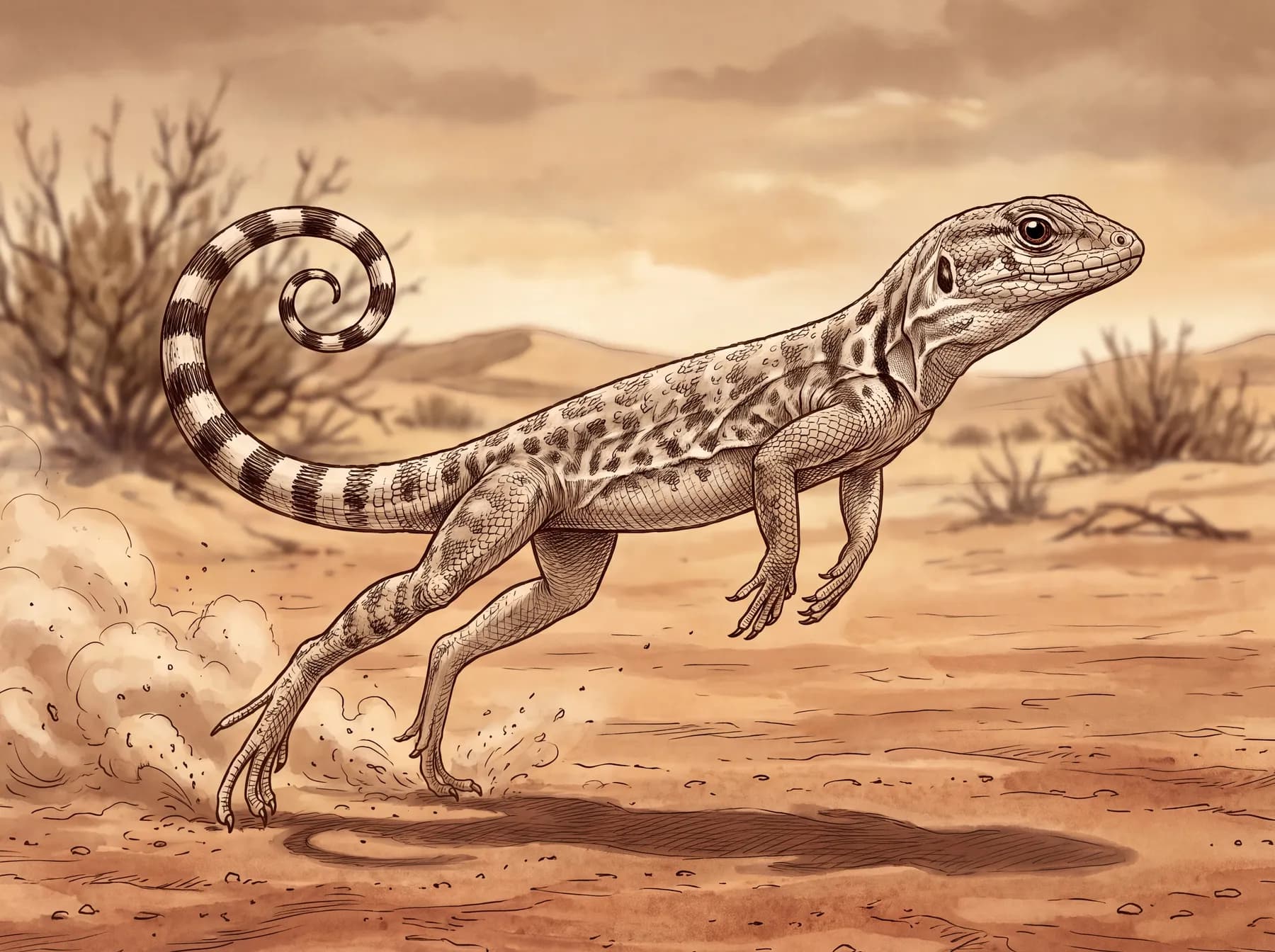
A zebra-tailed lizard does the last thing you would expect of a small animal on open ground: when something watches it, it curls its tail up over its back and waves it. The top of the lizard is cryptic sandy gray and hard to hold against the flat. The underside of that tail is not. Bold black-and-white bands run across it, and they show only when the tail is curled and flashed. A pale lizard with nowhere to hide is waving a flag at whatever might eat it.
The obvious reading is fear, a frightened animal twitching before it runs. That is the one thing the wave is not. Biologists once put four escape-related explanations against each other: that the flash helps the lizard vanish, that it lures a strike onto the tail, which can break off and regrow, that it warns other zebra-tails, and that it speaks to the predator itself. The first three failed the test. What held was pursuit-deterrence — the wave is a message aimed at the hunter, telling it the lizard has already seen it and a chase is not worth starting.
It is a message the lizard meters, too. Researchers found the signal appears most often at intermediate risk: not when a threat is barely a threat, and not when it is serious enough that the animal should just leave. The waving can run before, during, and after a sprint, carrying on as long as 13 seconds after the run is over, which is not how a nervous reflex behaves.
The message only works if the threat behind it is real, and this lizard can make it real. Field measurements clock it at up to 4 m/s, about 50 body lengths per second, which may make it the fastest lizard in the desert. Around 30% of its strides are bipedal: the front end rises, the body runs upright, and the long tail trails behind as a counterweight. Scale 50 body lengths a second up to a person and the arithmetic comes out near two hundred miles an hour, a figure that says nothing honest about human running and everything about how this animal is put together.
How it runs is stranger than how fast. Its hind foot is huge, close to 40% of its body length, the largest among lizards its size. On hard ground the foot works as a spring: the animal runs on the toe tips, and tendons give back about 40% of the work of each step. On loose sand the same foot flattens, buries, and turns into a paddle rotating below the surface. One foot, two machines, chosen by the ground underneath it.
Sand should cost it dearly, and it does, though not where you would look for the bill. On loose ground the muscles of its upper hind leg do three times the mechanical work of a step on firm ground, and yet its top speed does not measurably drop. It pays the tax in effort and keeps the pace. This is an animal of the most exposed running ground there is: open flats, sandy washes, and desert pavement, where it stays out working in heat that sends other lizards under cover. A countersunk lower jaw lets it shovel down into loose sand to rest rather than dig a true burrow.
At ~3,050 feet in Joshua-tree and blackbrush country, this ground sits well inside the lizard's elevation range, though none has turned up here for us yet. The gray back is built to disappear, so the tail is what gives it away.
You will likely see the flag before the lizard: black-and-white bands waving low over open sand, then a gray blur running out from under them.