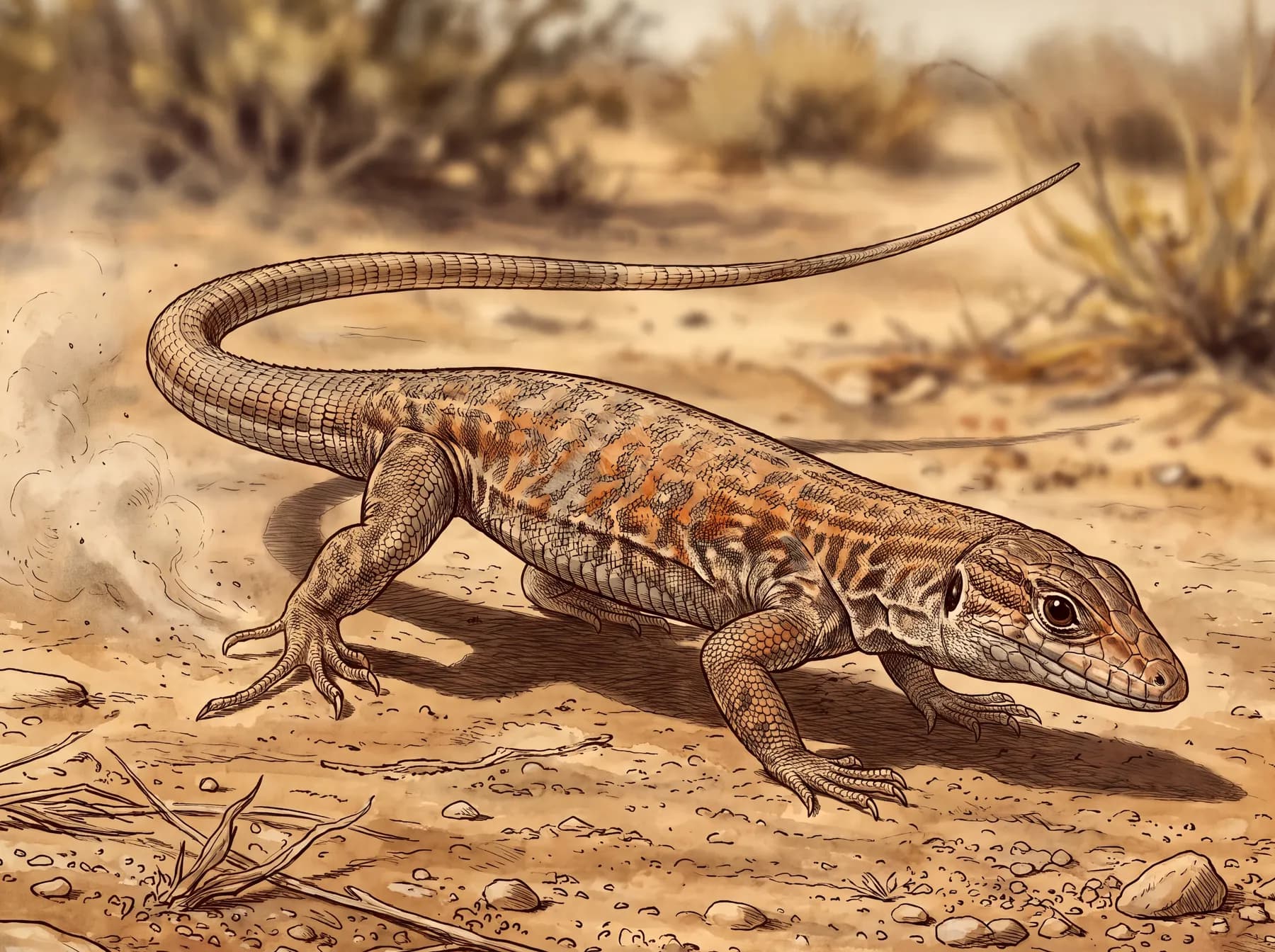
A western whiptail spends nearly all of its waking hours in motion, nose down, its long tail trailing, rooting through the litter under a blackbrush and digging into the soil. It is an active forager, not one of the sit-and-wait lizards that pick a warm rock and ambush whatever wanders past. The restlessness itself is the best way to recognize it: a lizard that is always rummaging, never posing, is very likely this one.
Most of what it hunts, it cannot see. Whiptails locate prey by chemical sampling, flicking a forked tongue across the ground to read scent, which lets them dig larvae and termites out from under the surface. One 1985 diet study found termites in 32 percent of the stomachs it examined, along with grasshoppers and beetles. It is not tearing open dead wood. It is working the soil and litter at the base of shrubs, following a smell down to something buried.
All that digging costs more energy than sitting and waiting, and the lizard pays for it by running hot. Southwestern whiptails of this genus hold a field body temperature somewhere around 38 to 41 degrees Celsius, kept there by shuttling between sun and shade through the morning. It is why you see them work the warm hours and disappear from the worst of the midday and midsummer heat. That is efficiency, not toughness. In Joshua tree and blackbrush, this bajada sits mid-slope of their Arizona range, which runs from the river up to about 5,500 feet.
There is a famous story about whiptails, and it belongs to the family more than to this lizard. The genus Aspidoscelis holds the largest group of all-female, cloning vertebrates known, species with no males at all, every daughter a copy of her mother, each founded long ago by a single hybrid mating. The western whiptail is not one of them. It breeds the ordinary way, and the males carry a dark gray throat and chest that an all-female clone could never show. The lineage that actually mothered the best-known clone was a marbled relative from the Chihuahuan Desert, far to the east; close enough in name to blur the two, far enough in fact that the lizard on this ground is neither a clone nor a clone's parent.
The constant motion has a cost beyond calories. It also makes the whiptail easy to see, and a staple of the greater roadrunner; during the breeding season, whiptails can supply as much as 90 percent of the protein parents carry back to the nest. The same twitchy rummaging that turns up the termites also shows a hunting roadrunner where to look. The whiptail defends nothing and trusts its speed, its home range overlapping freely with its neighbors', while the spiny lizard on a nearby fence post does territorial push-ups.
Watch for the tell in the young ones: a whiptail barely grown wears a bright blue tail, fading to plain brown with age.