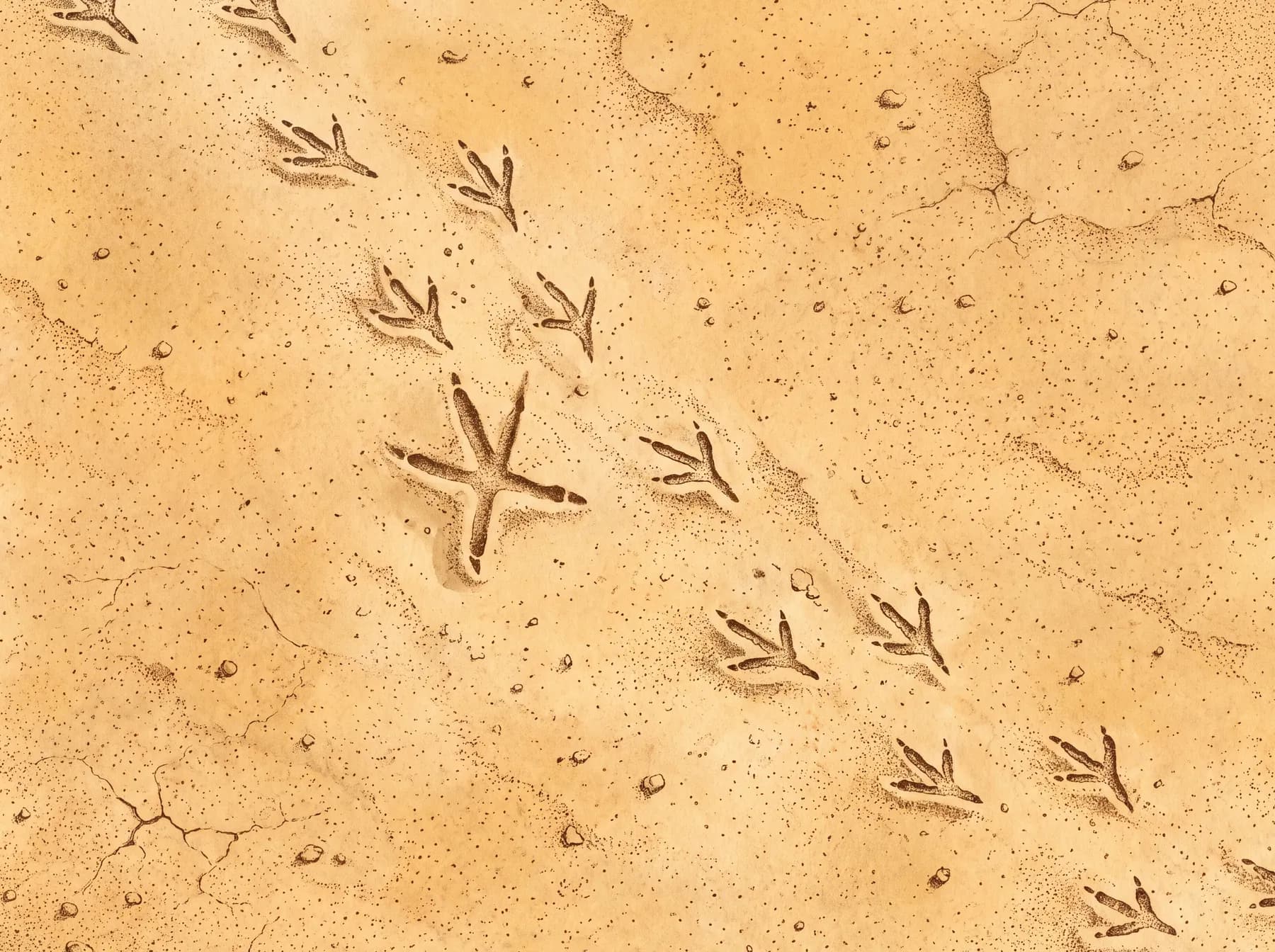
A bird leaves an arrow in the dust: three thin toes fanned forward, sometimes a fourth slim one pointing back, and a row of fine claw tips at the ends. No fleshy sole, no rounded pad, no print from a front foot, because a bird walks on its two hind feet only. Find one clean print like that and you have learned almost nothing, which is the first honest thing to say about bird tracks.
Almost every bird here presses the same basic foot. The arrangement has a name, anisodactyl, three toes forward and one back, and a songbird, a dove, and a raven all share it. Size is supposed to sort them, but a track in soft sand spreads and a track in dry crust shrinks, and the ranges overlap where the birds do. Game birds make it harder still: a quail's hind toe is small and often does not register, so its track drops to three forward toes and reads like something smaller than the bird that made it.
One track breaks the pattern, and it is the one worth memorizing. The greater roadrunner is zygodactyl, two toes forward and two back, and it prints a rough X in the dust. The odd part is that the X looks the same coming and going, so a single roadrunner print will not tell you which way the bird was headed. Trackers call it the which-way track. Nothing else on this ground leaves it.
When the print will not settle it, stop reading the foot and read the line. Birds that walk (quail, dove, roadrunner, raven) leave an alternating, single-file trail, one foot then the other, going somewhere. Small songbirds hop, landing both feet together, so their sign is a ladder of paired prints set side by side. Corvids are the ones people misread: a raven does not hop, it walks and skips, dropping offset pairs in a wide, swaggering line that toes inward. So a big trail that hopped belongs to something else, and a big one that walked and skipped is the raven.
Two things fake a bird. A lizard leaves five splayed clawed toes, both front and hind feet, and usually a continuous tail drag scribbled down the middle; a bird gives you three or four thin toes, hind feet only, and no tail line. A mammal walks on padded paws, a fleshy sole and rounded pads, while a bird walks on thin, unpadded toes tipped with pin claws. When you are unsure, look for the pad. Birds do not have one.
And birds sign the ground in ways that are not tracks at all. A shallow scratched bowl in dry dust, reused and often shared, is a dust bath, where a bird works grit down into its feathers to smother parasites and soak up preen oil. A splash of whitewash marks a roost overhead. A raptor coughs up a tight pellet of fur and bone below its perch. Paired backward kicks in the leaf litter are a bird foraging, not a digging animal.
So find the print, then walk the trail. Single-file means a walker; a clean X in the dust means a roadrunner went by, direction unknown.