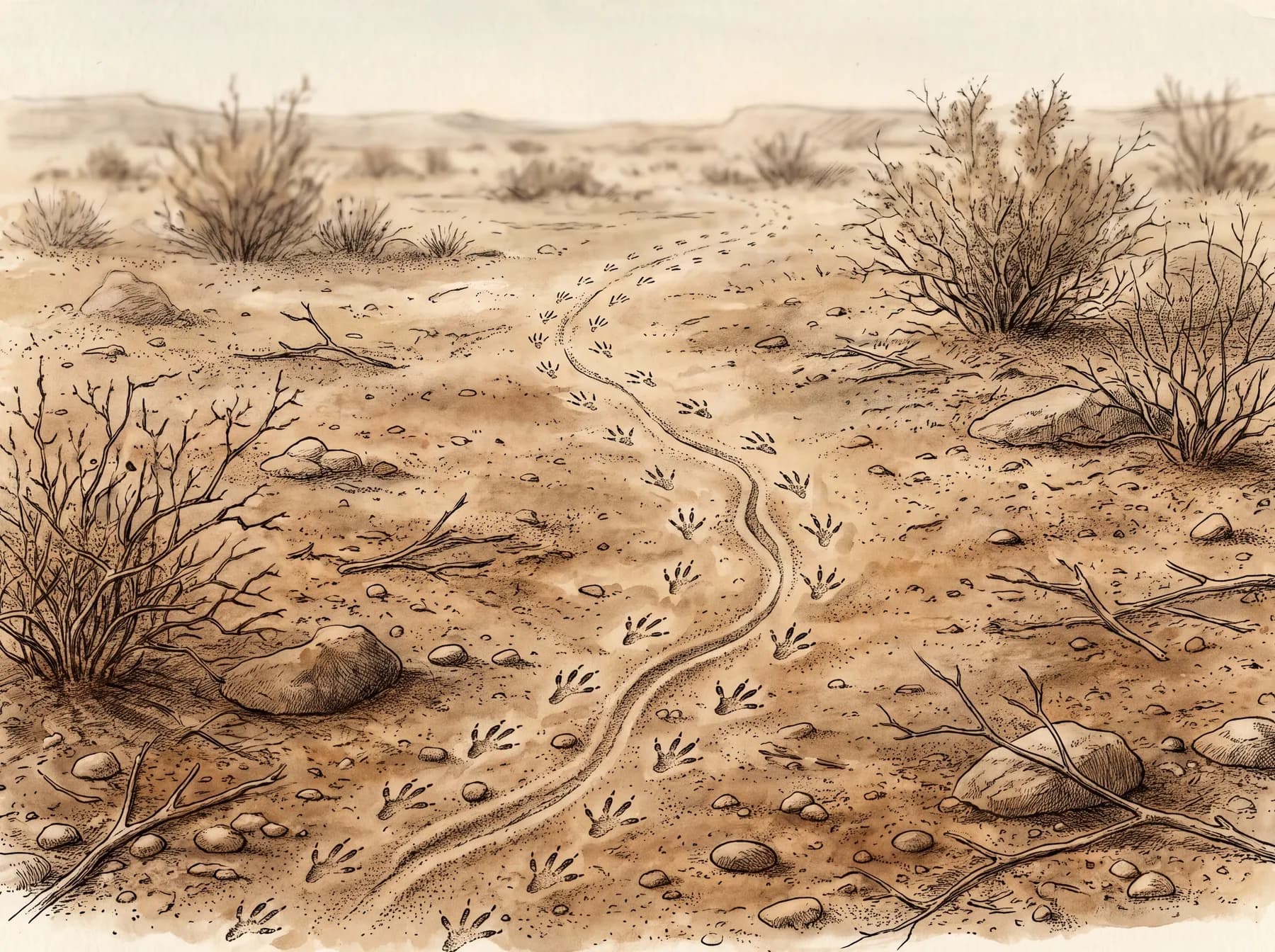
The sign to learn first is not a footprint at all but a line. Down the middle of a patch of fine sand runs a single thin drag mark, and stepping along both sides of it, straddling it left and right, are two rows of small splayed prints. Something walked here dragging its tail, and the tail wrote the clearest part of the record.
Kneel and read one of the prints. It is a small splayed hand, five toes tipped with fine claws, and on the hind foot the toes are uneven in a telling way. The fourth toe is the longest, and the fifth splays distinctly outward from the rest. That outward-kicked toe is the signature. The front prints are smaller and often faint, sometimes set down under the hind ones, so it is the hinds you learn to read.
Now the line itself, because this is where a tidy guess goes wrong. It is tempting to call the drag a wandering, snaking mark. That is the wrong word. A lizard's tail line stays relatively straight and thin, a gentle wander at most, held roughly down the center of the trackway. Straightness is the tell. A salamander drags its tail too, but in a strong side-to-side undulation; the lizard's stays close to a line. If the drag is snaking hard, you are probably not looking at a lizard.
Two other makers leave prints in the same ground. A kangaroo rat bounds, so its hind feet land in pairs, hop-groups spaced down the trail. The lizard instead marches, feet in alternating diagonal pairs, left then right, never doubled up. A bird shows three or four toes, no front prints, and no continuous tail drag. Five splayed clawed toes, front and hind, plus that central line, and you have a lizard and neither of the others.
Then there is the trail that seems to change its mind. On some stretches the drag thins and vanishes and the prints become hind feet only, spaced progressively farther apart. Fast lizards like the zebra-tailed lizard and the desert iguana rise onto their back legs to sprint, carrying the tail up as a counterweight. It can look as though the animal went from four legs to two at a single footfall, though that reading is more evocative than settled.
Read it at first light, before the wind sands the detail away. The straight line down the middle is what to find first.