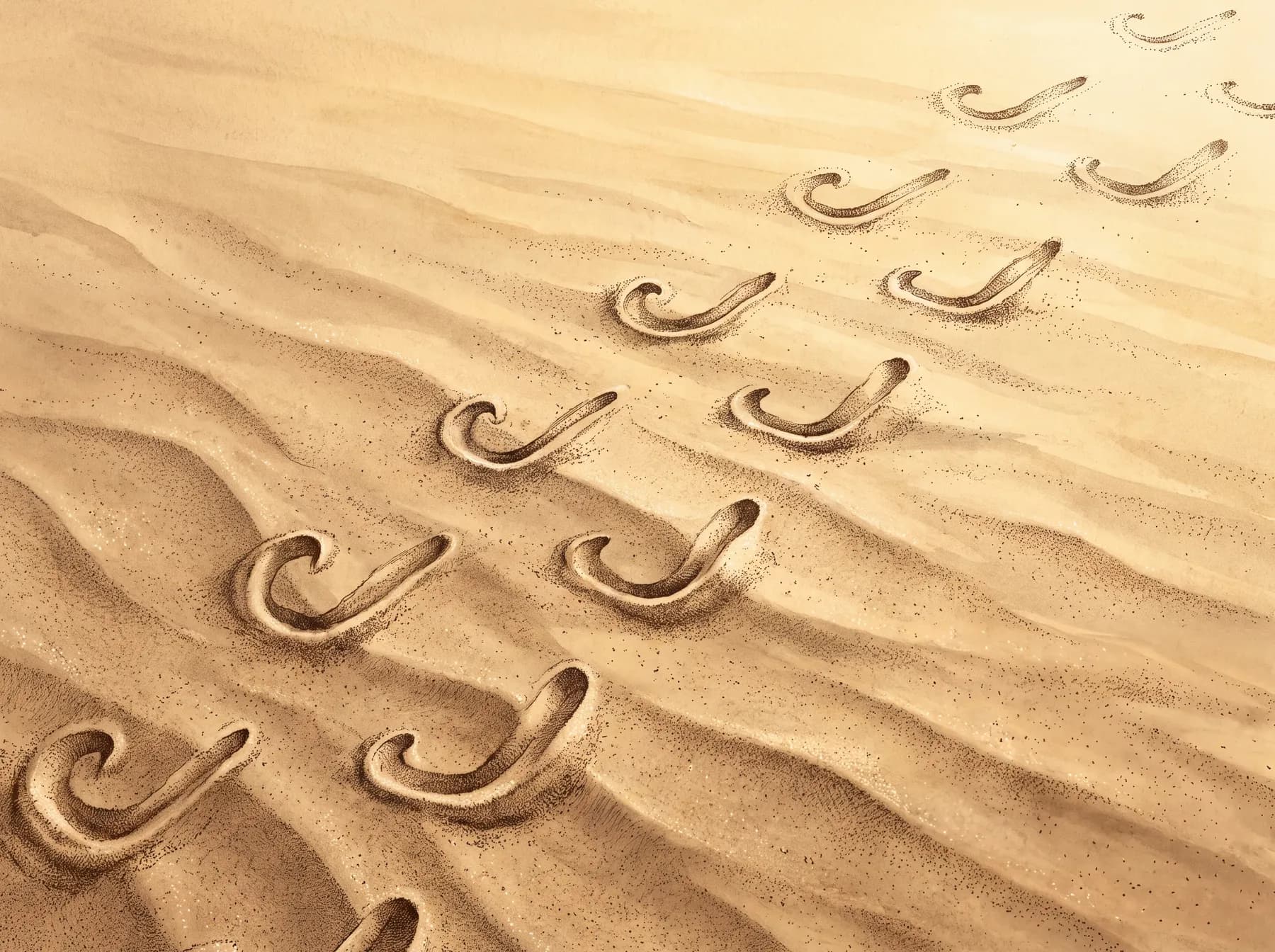
Most snake trails you find are a single line, one long wavy furrow dragged across the sand. This one is not a line. It is a row of separate marks, each a short bar pressed clean into loose sand with a gap of undisturbed ground between it and the next, the whole set leaning the same way like rungs knocked off a ladder. The instinct is to hunt for the connecting groove. There isn't one. That absence is the identification.
Look closely at a single bar. It runs mostly straight, then curls into a small hook at one end, closer to a J than to an S. And it is long, about as long as the snake that made it, because the snake laid nearly its whole body down at once to press it. An adult sidewinder runs roughly 17 to 31 inches, so one bar can be most of two feet of sharp-edged track. If the sand is fine, you may find the belly scales printed inside it, stamped rather than dragged.
The reason the trail comes apart is that the snake never really moves forward. It throws loops of its body sideways, and at any moment only two points touch the ground while the rest is lifted clear. Each touchdown presses one bar; the lifted stretches leave the gaps. On loose, grip-less sand that an ordinary slither cannot hold, and on a surface hot enough to matter, this buys two things at once: a static point to push against, and most of the body kept up off the ground.
So which way did it go? The trap is to read along the bars, as though the snake crawled down the length of one. It did not. It traveled across them, obliquely, at an angle rather than a right angle, stepping from bar to bar staircase-fashion. The hook end is the head and neck, and the hooks step along in a line that points the way. Connect the hook tips of one bar to the next, and that line is the direction of travel. Do not trust a single curl to point it for you.
It belongs on this bajada as a possibility rather than a confirmed neighbor; the range and the loose sand fit, but we have not yet found the trail here. When it turns up, it will likely be at night, since the animal is small, sand-coloured, and nocturnal through the heat. It is a rattlesnake, venomous, mild as rattlers go but a real one, and worth a wide berth.
Separate bars, not one wavy line. Follow the hook tips, not the curl. And give whatever left them the night, and the room.