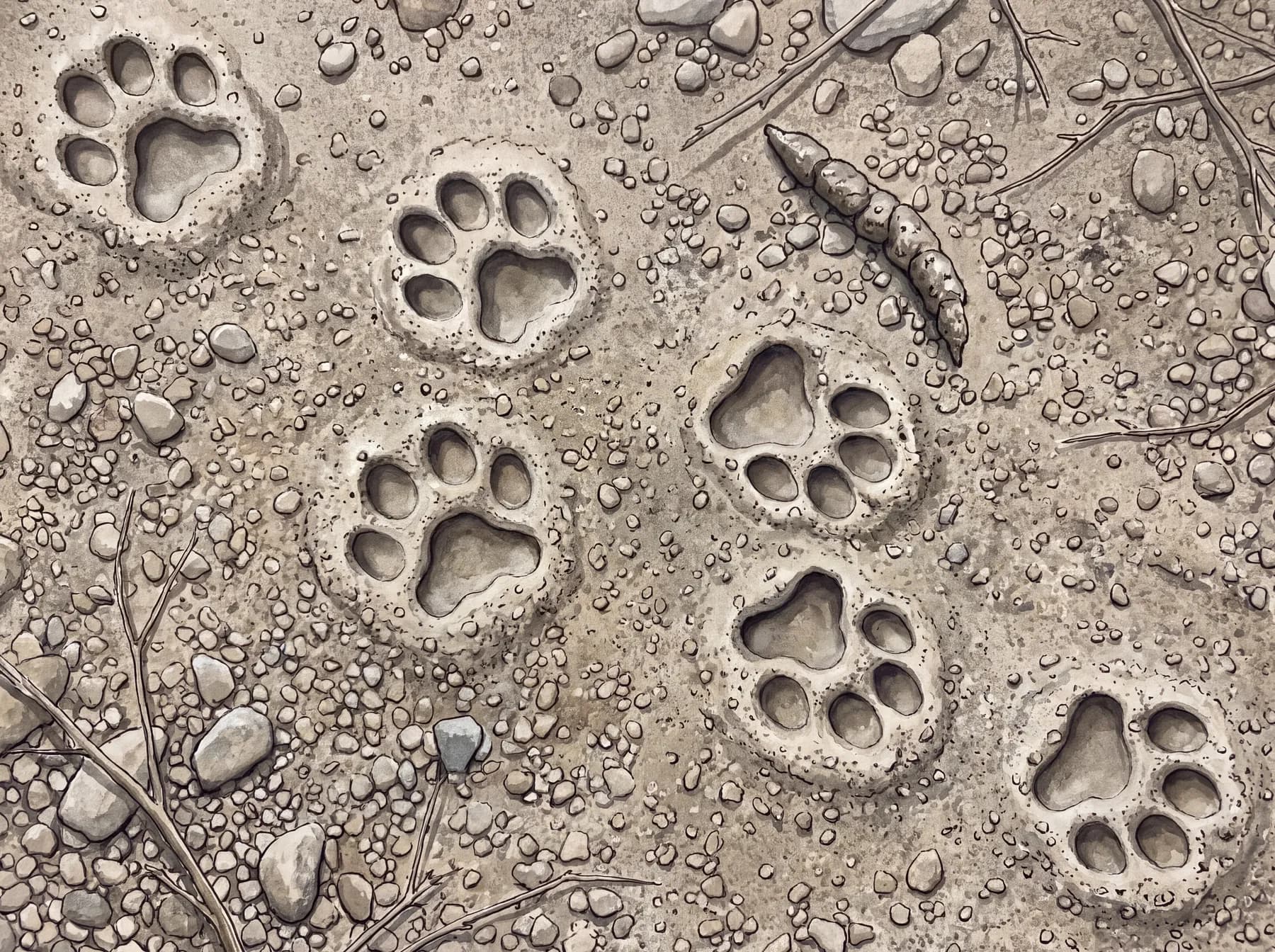
A pawprint in wash dust, round and about two inches across, four toes riding above a big pad, and the detail that matters most is the one that is not there. No claw marks. A dog or coyote presses small sharp points into the ground ahead of each toe, because a canid cannot pull its claws back. A cat can, and walks with them sheathed. So a clean, clawless, roughly round print is the first note toward a bobcat.
First note, not the verdict. Absence is a soft clue, since a shallow print in hard ground may not record the fine detail at all. So do what the coyote page also asks: stop trusting one feature and read the shape of the empty space inside the track.
Here the two animals split cleanly. Between the four toes and the heel pad, a coyote leaves a crisp X of open ground. A bobcat leaves a C, a squashed and rotated crescent of negative space with no clean X anywhere in it. Look at the pad itself and the case gets stronger. A bobcat's heel pad is large against the small toes, and its edges are lobed: two lobes along the leading edge, three along the trailing one, which together read as a wide letter M pressed into the dust.
Then there is size, which sorts the two cats that range this bajada. A bobcat print runs around two inches across, close to a big house cat. At about three inches and up you are no longer reading bobcat; you are reading mountain lion. Round rather than oval, small toes over a big lobed pad, and that two-inch scale together make the call the way no single one of them can.
The trail confirms it. A walking bobcat sets each hind foot down where the front foot already landed, printing a neat single line, direct-register, with a step of roughly six to fourteen inches and the two sides of the trail four to nine inches apart. There is a second signature it leaves on purpose. Bobcat scat is a hard, dense, segmented cylinder with blunt ends, about half an inch to an inch thick, often scraped over with dirt or set on a low mound. Covered or mounded, the placement is deliberate.
One shallow print settles nothing. On the next round track in the dust, look first for the claws that are not there.