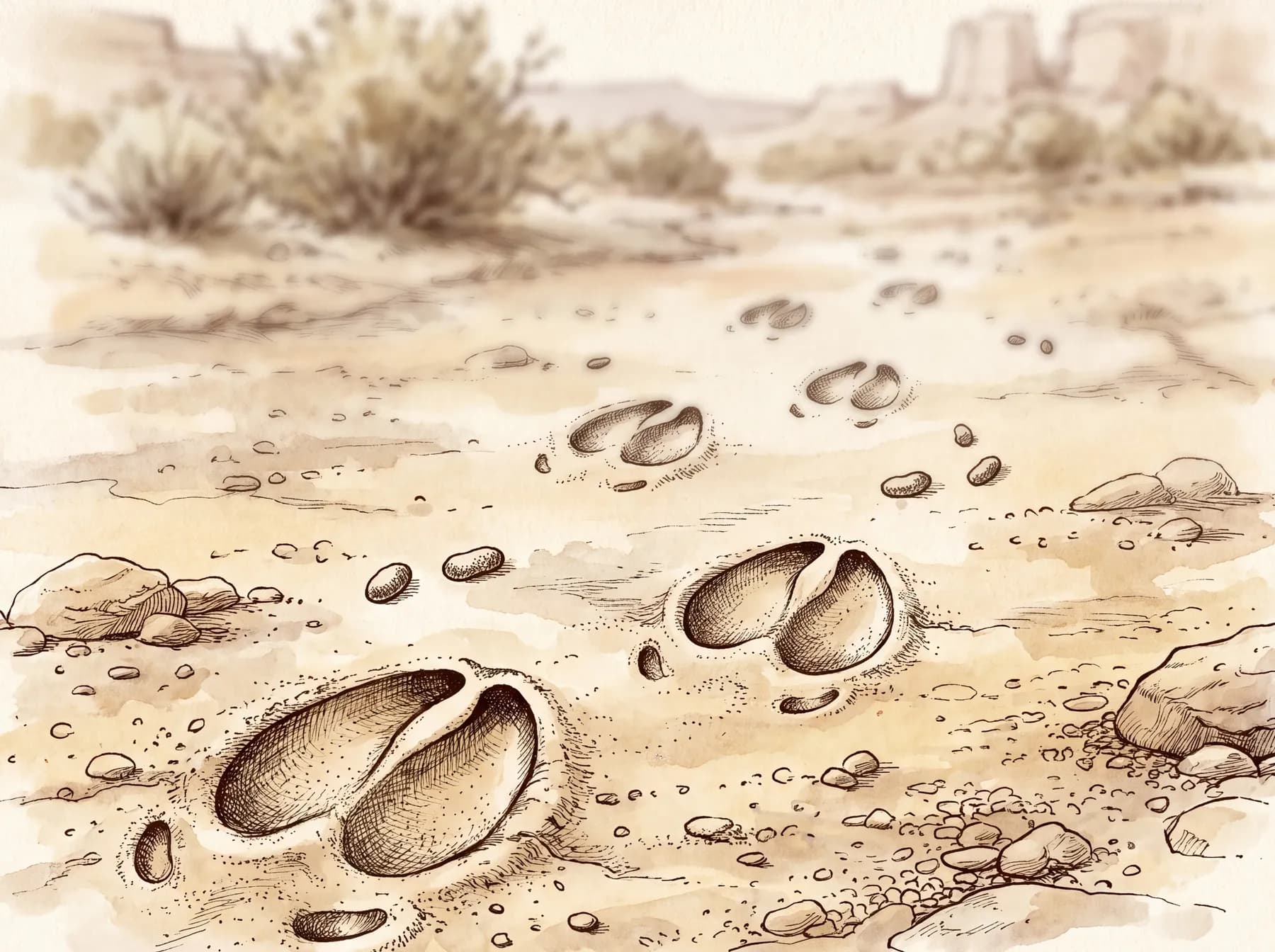
A cloven hoof presses a heart into the ground, drawn point-first. Two halves, each a teardrop tapering to a point at the leading edge, with the rounded lobes trailing behind. On this bajada that shape means deer, and the point is not decoration: it aims the direction the animal was traveling. An adult front hoof prints roughly 1.8 to 3.2 inches long, a clean walking track landing close to 3 inches, with the hind foot slightly smaller and dropping behind it.
The catch is that a heart is not the only split hoof on this ground. Two toes and a seam down the middle also describe the desert bighorn, and its track runs a similar size. The tell is the edge. A bighorn print is blockier and straighter-sided, without the clean taper to a point that a deer leaves. Habitat helps settle it too: bighorn favors steep rock, while deer work the browse and the washes. The other look-alikes are easier. A burro leaves one solid U-shaped hoof, a single toe, never cloven. A dog or coyote leaves a padded paw with claw tips and no hoof at all.
Substrate keeps rewriting the same foot. On firm, dry ground you read the tidy two halves and nothing else. Press that hoof into deep sand, or catch the animal moving fast, and two new marks arrive: the halves splay apart, and a pair of small round dots print behind the hoof. Those are the dewclaws, and they stay off the page on a calm walk. A faint drag line scuffed between prints usually just means soft, dusty ground and feet not lifting clear.
The surest read, though, is not in any single print. It is in the spacing. A walking deer lays an alternating, nearly single-file line, stride about 15 to 25 inches; a trot stretches that to 33 to 50. Alarmed, the animal stots — all four feet strike the ground together and launch together — so the trail breaks into tight clusters of four prints with wide empty gaps between the groups. A whitetail does not do this. Of everything a deer leaves behind, that bounding cluster is the one sign that identifies it on its own.
Where a deer has been browsing, look down for loose piles of oblong pellets, each pointed at one end and dimpled at the other, roughly 0.4 to 0.6 inch long. On dry winter browse they drop separate and firm. On green, wet forage they can fuse into a soft clump instead, a clue about the season and the food, not a way to read the animal's size or sex.
One heart in the sand can fool you. Four bunched tight, a gap of bare ground, then four more: a deer running scared.