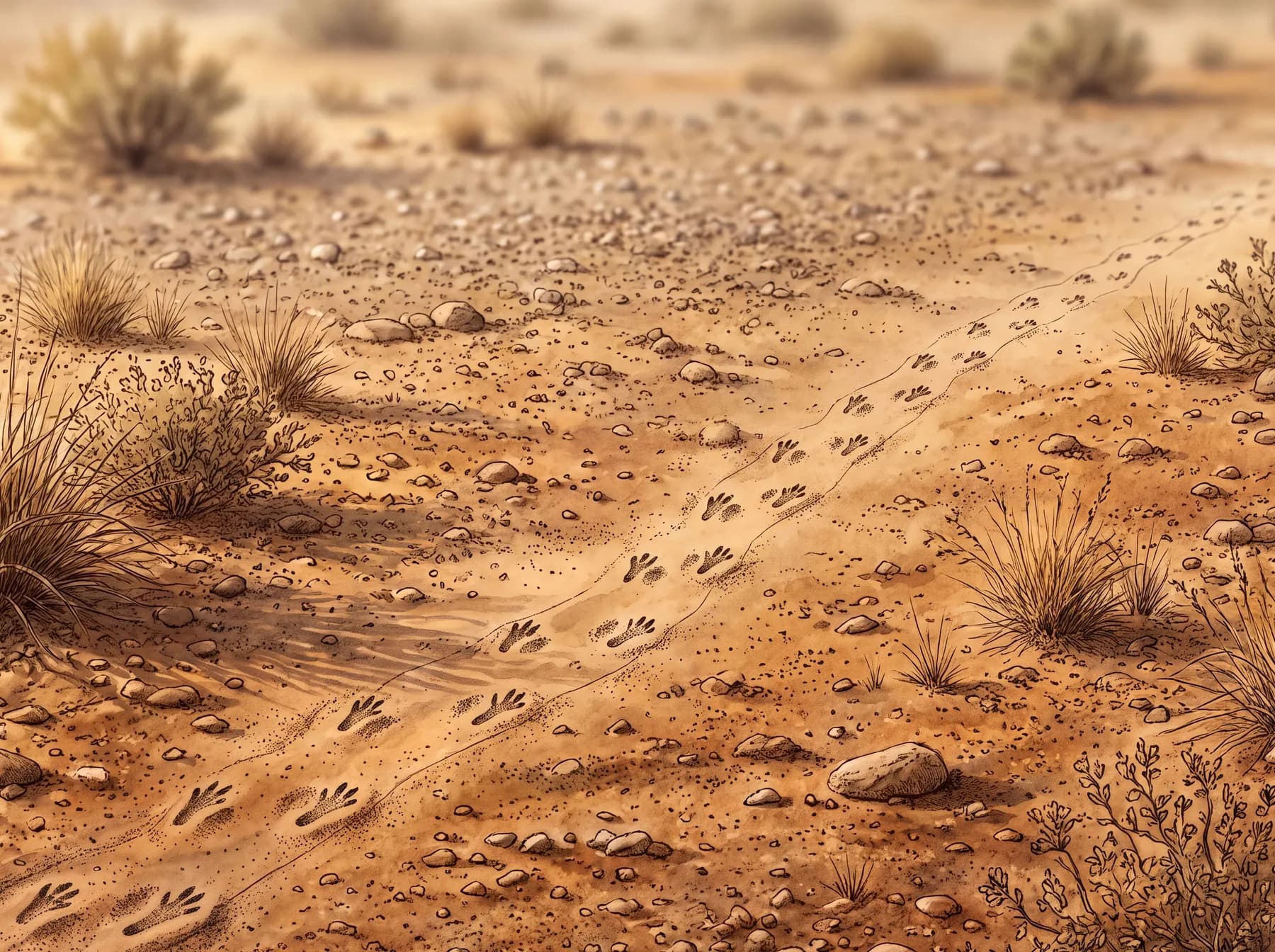
Two small prints, side by side, then a gap, then two more just like them, marching down a patch of loose sand. Not four prints in a cluster. Two. That pairing, repeated, with clear space between each set, is the whole signature of a kangaroo rat, and almost nothing else on this ground writes it.
The reason there are two and not four is that the animal travels on its hind feet alone, a bipedal ricochet hop like a small kangaroo. The front feet are tiny and usually never touch down, so they leave nothing to read. Each hind print is small and soft-edged, pressed by a furred sole, and if the sand holds it you can count four toes. The fifth is vestigial and rarely marks at all. What gives the maker away is not size but spacing: the gaps between pairs run several inches, far longer than you would expect from an animal this small. A mouse-sized track taking rabbit-sized leaps is the tell.
There is a tempting detail that gets over-read: a fine line dragging down the center, stitched between the pairs. It is the tail, real enough, but not always present. A kangaroo rat drags its tail when it moves slowly, foraging in tight hops, and lifts it when it hops fast. Read a slow foraging trail and the center line shows; read a bounding escape and it vanishes, the pairs flung several feet apart and scattered. The tail line confirms the maker when it is there, but its absence proves nothing.
The look-alikes sort out by counting prints per group. A pocket mouse is the likeliest confusion, close in size and sharing the same sand, but it bounds on all four feet, so its trail comes in groups of four, not two. Four prints to a set means you are not looking at a kangaroo rat. A bird leaves a different pattern again: single-file, alternating, splay-toed, nothing like these repeating padded pairs.
You will read all of this best in loose, wind-blown sand near a burrow, and best of all at night or in the first light, before the wind smooths the record away. One caution: finding the track in sand does not make this a sand-only animal. Merriam's kangaroo rat tolerates harder, stonier ground too. The sand is simply where the sign prints clearly enough to teach you what it looks like.
Count the prints in one group. Two, with long gaps between, means kangaroo rat. Four means something else entirely.